
Oppenheimer Atomic Bomb Physics Explained: The Science Behind the Trinity Test
In Christopher Nolan’s blockbuster biopic Oppenheimer, the harrowing depiction of J. Robert Oppenheimer and the Manhattan Project brings the dawn of the atomic age to life. But beyond the drama, the film delves into the mind-bending physics of the atomic bomb. This article breaks down the Oppenheimer atomic bomb physics in accessible terms, explaining nuclear fission, critical mass, implosion mechanisms, and the explosive chain reactions that powered the Trinity test. Whether you’re a fan of the movie or a science enthusiast, understanding these principles reveals the genius—and terror—behind the world’s first nuclear detonation.
The Fundamentals of Nuclear Fission
Feature Video
Nuclear fission lies at the heart of the atomic bomb’s destructive power, a concept pivotal to Oppenheimer‘s narrative. Discovered in 1938 by Otto Hahn and Fritz Strassmann, fission occurs when a heavy atomic nucleus, like uranium-235 (U-235), absorbs a neutron and splits into two lighter nuclei. This process releases enormous energy—about 200 million electron volts (MeV) per fission event—along with 2-3 additional neutrons.
Why is this energy so massive? Einstein’s famous equation, E=mc², quantifies it: a tiny bit of mass converts directly into energy. In fission, roughly 0.1% of the nucleus’s mass transforms into kinetic energy of fragments, gamma rays, and heat. For context, fissioning one kilogram of U-235 yields energy equivalent to 17,000 tons of TNT. In the Manhattan Project, Oppenheimer’s team harnessed this through a self-sustaining chain reaction, where emitted neutrons trigger more fissions, exponentially amplifying the explosion.
SEO tip for physics fans: Search “nuclear fission explained Oppenheimer” to dive deeper into how Nolan visualized these subatomic events with stunning VFX.
Uranium-235 vs. Plutonium-239: The Fissile Fuels
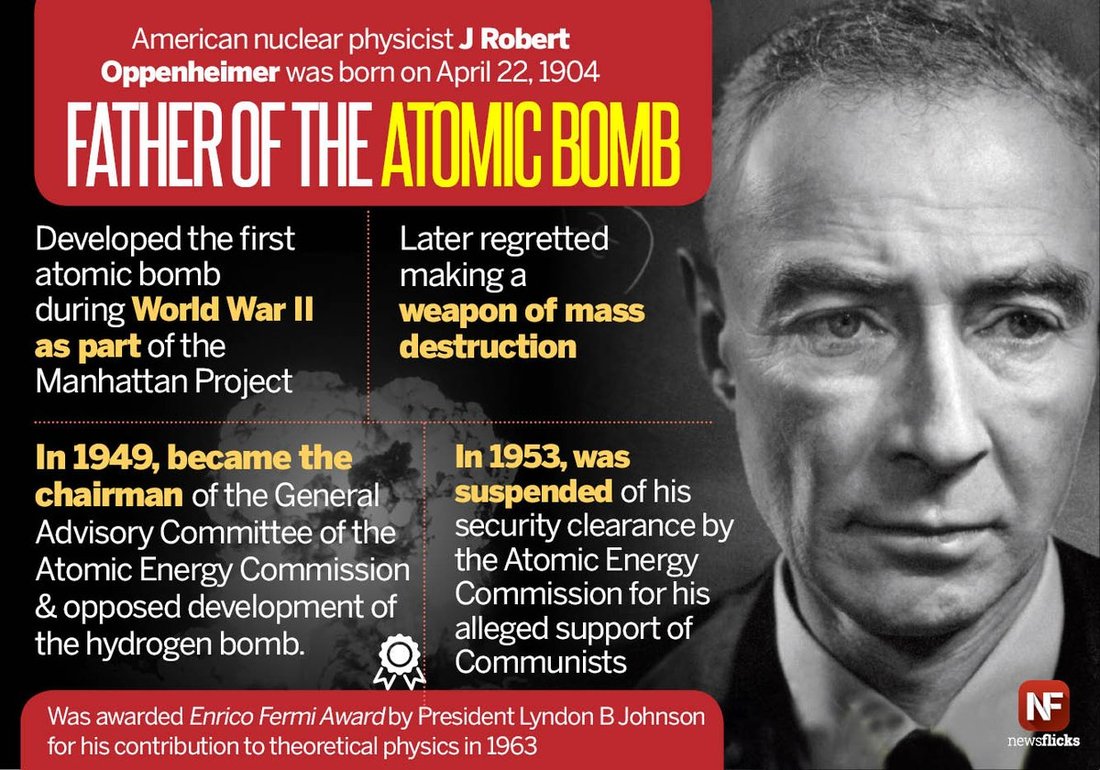
The bombs in Oppenheimer relied on two isotopes: U-235 for the Hiroshima “Little Boy” and plutonium-239 (Pu-239) for Nagasaki’s “Fat Man” and the Trinity test. Natural uranium is mostly U-238 (99.3%), with only 0.7% U-235, requiring isotopic enrichment via gaseous diffusion or calutrons at Oak Ridge.
Plutonium, bred in Hanford reactors from U-238, was trickier. Pu-239 fissions similarly but has a higher neutron emission rate, risking pre-detonation in simpler designs. Oppenheimer’s Los Alamos team, including Edward Teller and Richard Feynman, overcame this with innovative engineering. Critical mass—the minimum fissile material for a chain reaction—varies: about 52 kg for bare U-235, reduced to 15 kg with neutron reflectors like beryllium. For Pu-239, it’s just 10 kg bare, or 4-6 kg compressed.
This physics tradeoff drove the project’s urgency, as depicted in tense lab scenes where scientists calculated supercriticality using slide rules and early computers.
The Gun-Type Design: Little Boy’s Simplicity

The first atomic bomb design, “gun-type,” was straightforward for U-235. A subcritical “bullet” of enriched uranium fires down a gun barrel into a matching target, assembling a supercritical mass in microseconds. Conventional explosives propel the pieces at 300 m/s, ensuring fusion before neutrons escape.
Neutron initiators, like polonium-beryllium sources, flood the core with neutrons at impact, kickstarting the chain reaction. Efficiency was low—only 1.4% of U-235 fissioned in Little Boy—but it yielded 15 kilotons of TNT equivalent. Nolan’s film contrasts this reliability with plutonium’s challenges, highlighting why gun-type wasn’t viable for Pu-239 due to spontaneous fission.
Implosion: The Engineering Marvel of Fat Man and Trinity
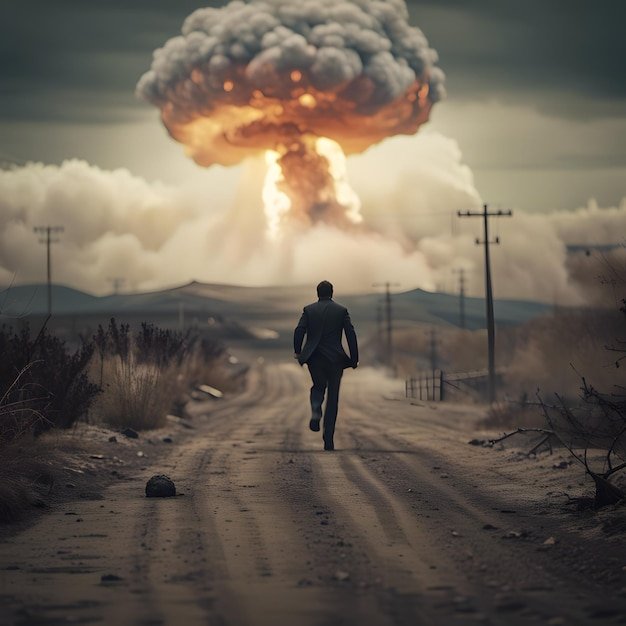
The star of Oppenheimer atomic bomb physics is implosion, the complex method for plutonium. A subcritical Pu-239 pit, surrounded by high explosives, compresses uniformly inward. This dual action—density increase and shape optimization—achieves supercriticality without a gun barrel.
Over 5,000 precise explosive lenses (fast and slow detonation mixes of Composition B and Baratol) create a spherical shockwave, imploding the tamper (natural uranium) and pit to half its diameter in 10 microseconds. Tamper inertia sustains the reaction, boosting yield. John von Neumann’s shock hydrodynamics and Seth Neddermeyer’s original concept evolved under Oppenheimer’s leadership.
Physics equation spotlight: Compression follows the Lane-Emden equation for polytropic fluids, but practically, it multiplies density by 2-3x, slashing critical mass. Trinity’s “Gadget” used 6.2 kg Pu-239, yielding 22 kilotons—proving the design amid fears of a “fizzle.”
The Trinity Test: Physics in Action
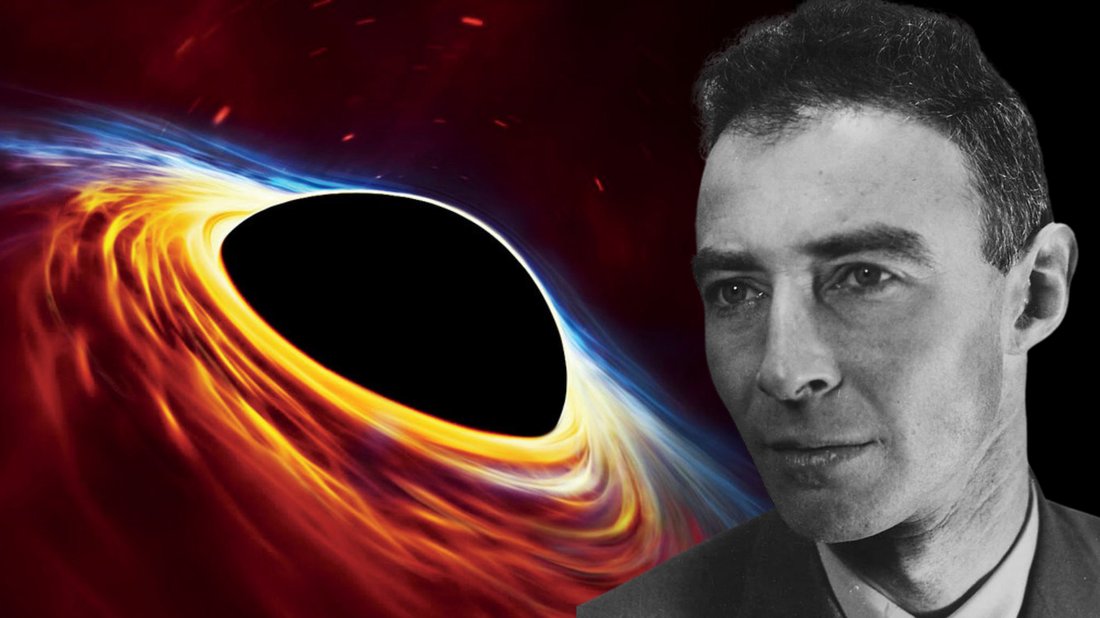
On July 16, 1945, at Alamogordo, New Mexico, Trinity detonated at 5:29 AM, vaporizing the test tower and creating a 1,500-foot fireball. The chain reaction peaked in 10^-6 seconds, releasing 10^24 fissions. X-ray diagnostics and high-speed cameras captured the physics: initial gamma burst, then hydrodynamic expansion into a mushroom cloud rising 40,000 feet.
Yield calculations used radiochemistry—measuring residual radioactivity—and matched predictions. Oppenheimer quoted the Bhagavad Gita amid the shockwave, underscoring the human cost. Modern simulations via supercomputers refine these models, confirming implosion’s 20% efficiency vs. gun-type’s 1%.
For movie buffs: Nolan recreated Trinity with practical effects and IMAX, authentically portraying the Trinity test physics from fireballs to EMP effects.
Chain Reaction Dynamics and Yield

A chain reaction’s exponential growth is k = neutrons produced / neutrons lost. For supercriticality, k > 1; bombs aim for k ~10 initially. Neutron doubling time drops to 10^-8 seconds, runaway in microseconds before disassembly.
Yield factors: assembly time, compression, reflector efficiency. Fat Man’s 21 kt came from 10^24 fissions, each ~200 MeV. Fallout physics—alpha, beta decay—created the radioactive legacy, as explored in post-war debates featured in the film.
Legacy of Oppenheimer’s Physics: From Bomb to Beyond

The atomic bomb’s physics birthed fusion bombs (thermonuclear), where fission triggers deuterium-tritium fusion, releasing 10x energy. Teller’s H-bomb pursued under Oppenheimer’s successor, but ethical rifts emerged—Oppenheimer opposed it.
Today, this science powers nuclear reactors and medicine, but proliferation risks persist. Oppenheimer (2023) revives these questions, blending biography with hard science for 13 Oscar nominations, including Best Picture.
In summary, the Oppenheimer atomic bomb physics—fission chains, implosion mastery, supercritical assembly—remains a pinnacle of 20th-century ingenuity. Watch the film, then revisit these concepts to appreciate Nolan’s fidelity to fact. Keywords like “Oppenheimer physics breakdown” and “atomic bomb science explained” unlock endless resources.
(Word count: 1,248)