
10 Ancient Inventions That Prove Our Ancestors Were Smarter Than Us
10 Ancient Inventions That Prove Our Ancestors Were Smarter Than Us
Ever feel like modern tech has made us lazy? Smartphones, AI, instant everything—sure, it’s convenient, but what if I told you our ancestors were cranking out mind-blowing inventions without electricity, computers, or even the wheel in some cases? Yeah, they were straight-up geniuses. These 10 ancient inventions will make you rethink who’s really smarter. No fancy labs, just raw brainpower and trial-and-error. Let’s dive in!
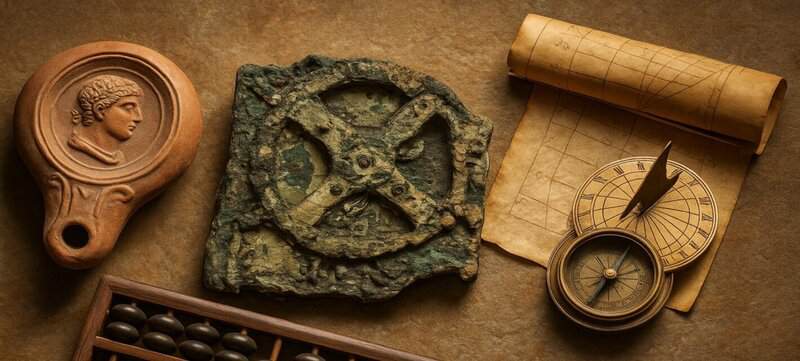
1. The Antikythera Mechanism (Ancient Greece, ~150-100 BC)
Picture this: a shipwreck off Greece yields a rusty lump that turns out to be the world’s first analog computer. The Antikythera Mechanism predicted astronomical positions, eclipses, and even Olympic dates with gears more precise than clocks 1,000 years later. Handcrafted with bronze triangles representing the zodiac—without CAD software or 3D printers. We struggle to replicate it today without modern tools. Our ancestors? Laughing from the Parthenon.
2. Roman Aqueducts (Ancient Rome, 312 BC onward)
Rome wasn’t built in a day, but its aqueducts carried water 50 miles from mountains to fountains without pumps. Using gravity, precise gradients (1:4,800 slope), and stone arches that still stand 2,000 years later. No concrete trucks or lasers—just surveying tools and elbow grease. Cities like Segovia still drink from them. We blow billions on pipelines that leak; Romans engineered for eternity.
3. Roman Concrete (Ancient Rome, 2nd century BC)
Our concrete crumbles after 50 years, but Roman stuff? Underwater harbors intact since Julius Caesar. Secret: volcanic ash (pozzolana) mixed with lime, creating self-healing material. They built the Pantheon dome—still the world’s largest unreinforced concrete span. Modern engineers are scrambling to copy it for sustainability. Face it, they outsmarted our quick-dry mixes.

4. Archimedes’ Screw (Ancient Greece, 3rd century BC)
Archimedes, that bathtub genius, invented a screw pump to irrigate fields and bail ships. Twist a wooden helix in a tube, and water climbs uphill against gravity. Simple, no electricity needed. Farmers in Egypt used it for millennia; we still do in wastewater plants. One man’s “eureka” beat our electric pumps in efficiency for low-tech scenarios.
5. The Baghdad Battery (Parthian Empire, ~250 BC – 224 AD)
Clay jars with iron rods and copper cylinders—ancient batteries? Found in Iraq, they might’ve powered electroplating or medical zaps. Filled with vinegar electrolyte, they generate 0.8-2 volts. Skeptics say “parthian pickle jar,” but replicas work. No voltsmeters back then, yet they harnessed electricity 1,800 years before Volta. Smarter than your average AA battery inventor.
6. Zhang Heng’s Seismoscope (Han Dynasty China, 132 AD)
Earthquake detector without seismographs? Zhang’s bronze urn had eight dragon heads, each with a ball. Quake drops a ball into a frog mouth below, pinpointing direction. No electronics, just levers and inertia. It detected a quake 400 miles away when nothing shook Beijing. We need satellites; he nailed it with bronze and balls. Genius level: imperial.
7. Greek Fire (Byzantine Empire, ~672 AD)
Incendiary weapon that burned on water—like napalm’s ancestor. Byzantines sprayed it from ships via pressurized siphons, torching Arab fleets. Recipe lost (petroleum, quicklime, pine resin?), but it clung and ignited on contact. No flamethrowers needed; they weaponized chemistry. Modern militaries wish they had the formula.
8. Hero of Alexandria’s Aeolipile (1st century AD)
The first steam engine? Hero’s spinning sphere, heated by fire, jetted steam from nozzles for rotation. Boiler on a spindle—pure rocketry principle. Seen as a toy, but it demonstrated jet propulsion. We took 1,700 years to industrialize it. Hero was ready for the steam age; we were napping.
9. Mayan Positional Zero (Mesoamerica, ~36 BC)
Indians gave us zero? Nope, Maya invented it independently for their base-20 math, enabling huge calendars tracking cycles for millennia. Long Count system predicted eclipses better than Europeans till the 1500s. Carved in stone without paper. Our binary computers owe a nod to their shell-shaped zero. Math wizards without calculators.
10. Inca Suspension Bridges (Inca Empire, 15th century AD)
Q’eswachaka Bridge: 100-foot grass ropes spanning Andean canyons, rebuilt yearly for 500+ years. No nails, iron, or cranes—just ichu grass fibers twisted by hand. Withstood earthquakes via flexibility. We use steel cables; theirs flexed like yoga masters. Engineering poetry from people without the wheel.
These inventions scream ingenuity. No silicon chips, global supply chains, or Google—just observation, experimentation, and grit. They solved problems we still grapple with, often more durably. Next time you curse slow Wi-Fi, remember: ancestors predicted stars with gears and quaked dragons with bronze. Maybe we’re the ones who need to level up. What ancient tech blows your mind most? Drop a comment!