
Did Anastasia Romanov Survive Her Family’s Grisly Execution? The Jaw-Dropping Romanov Mystery Exposed!
The Night of Terror: The Romanov Family’s Brutal End
Watch Related Video Coverage
In the early hours of July 17, 1918, in the dimly lit basement of the Ipatiev House in Ekaterinburg, Russia, one of history’s most infamous executions took place. Tsar Nicholas II, his wife Alexandra, their five children—including the young Grand Duchess Anastasia—and several loyal retainers were awakened and led downstairs under the pretense of safety from approaching Bolshevik forces. What followed was a hail of bullets and bayonets that claimed the lives of the entire Romanov family. The Bolshevik revolutionaries, determined to erase the symbols of the old tsarist regime, showed no mercy. Eyewitness accounts from the executioners described chaos: screams echoing off the walls, smoke filling the air from gunfire, and bodies piling up in a gruesome heap.
The Romanovs had been held captive for months amid the Russian Revolution’s turmoil. Nicholas had abdicated in 1917, ending 300 years of Romanov rule. But why the mystery surrounding Anastasia? Reports from the scene suggested that some family members, including the younger ones like 17-year-old Anastasia and her brother Alexei, survived the initial volley due to jewels sewn into their clothing acting as makeshift body armor. Guards claimed to have finished them off, but rumors persisted almost immediately that not everyone died that night.
This event didn’t just mark the end of an empire; it birthed one of the 20th century’s greatest unsolved mysteries. For decades, the world wondered: Did anyone escape? And at the center was Anastasia, whose supposed survival captivated imaginations from Europe to America.
Who Was Grand Duchess Anastasia Romanov?

Born on June 18, 1901, in Peterhof Palace near St. Petersburg, Anastasia Nikolaevna Romanov was the youngest daughter of Tsar Nicholas II and Tsarina Alexandra. With her lively spirit, sharp wit, and mischievous blue eyes framed by bobbed blonde hair, she stood out among her more reserved siblings: Olga, Tatiana, Maria, and the hemophiliac heir Alexei. Anastasia was known for her pranks—sliding down banisters, teasing palace staff, and even staging playful “courts” where she judged her sisters’ mock trials.
Life in the opulent Alexander Palace was idyllic until World War I and the 1917 Revolution shattered it. The family was moved from place to place, enduring hardships that transformed the playful duchess into a resilient young woman. By 1918, Anastasia had grown into a 17-year-old fluent in multiple languages, skilled in embroidery, and deeply devoted to her family. Her letters reveal a girl who cherished small joys amid captivity, like tending to her dog Jimmy or sketching flowers.
Yet, Anastasia’s image evolved posthumously into a tragic fairy-tale princess. Hollywood and literature romanticized her as the “lost duchess,” fueling endless speculation. But was there truth to the legend, or was it all smoke from Bolshevik secrecy?
The Spark of the Survival Rumors

Almost before the basement gunsmoke cleared, whispers spread. Local peasants reported seeing a young woman fleeing the Ipatiev House, blonde hair matted with blood. Bolshevik guards’ conflicting stories—some claiming two bodies were missing—fanned the flames. The White Russian forces who captured Ekaterinburg days later found no bodies; the Bolsheviks had burned and buried them in a hasty grave in the Koptyaki Forest.
These inconsistencies ignited global intrigue. In a time without instant news, rumors traveled via émigré networks. By 1920, tales of Romanov survivors reached Europe. The Russian Orthodox Church refused to declare the family dead without bodies, preserving hope. Enter the impostors: over 200 people claimed to be Romanov relatives between 1918 and the 1980s, with Anastasia attracting more than 30 pretenders. Why her? As the feisty youngest daughter, she symbolized youthful resilience and escape against odds.
This phenomenon wasn’t unique—other royals like Louis XVII of France had similar claimants—but Anastasia’s story exploded due to media savvy and the allure of a Cinderella-like survival tale.
Anna Anderson: The Queen of Impostors
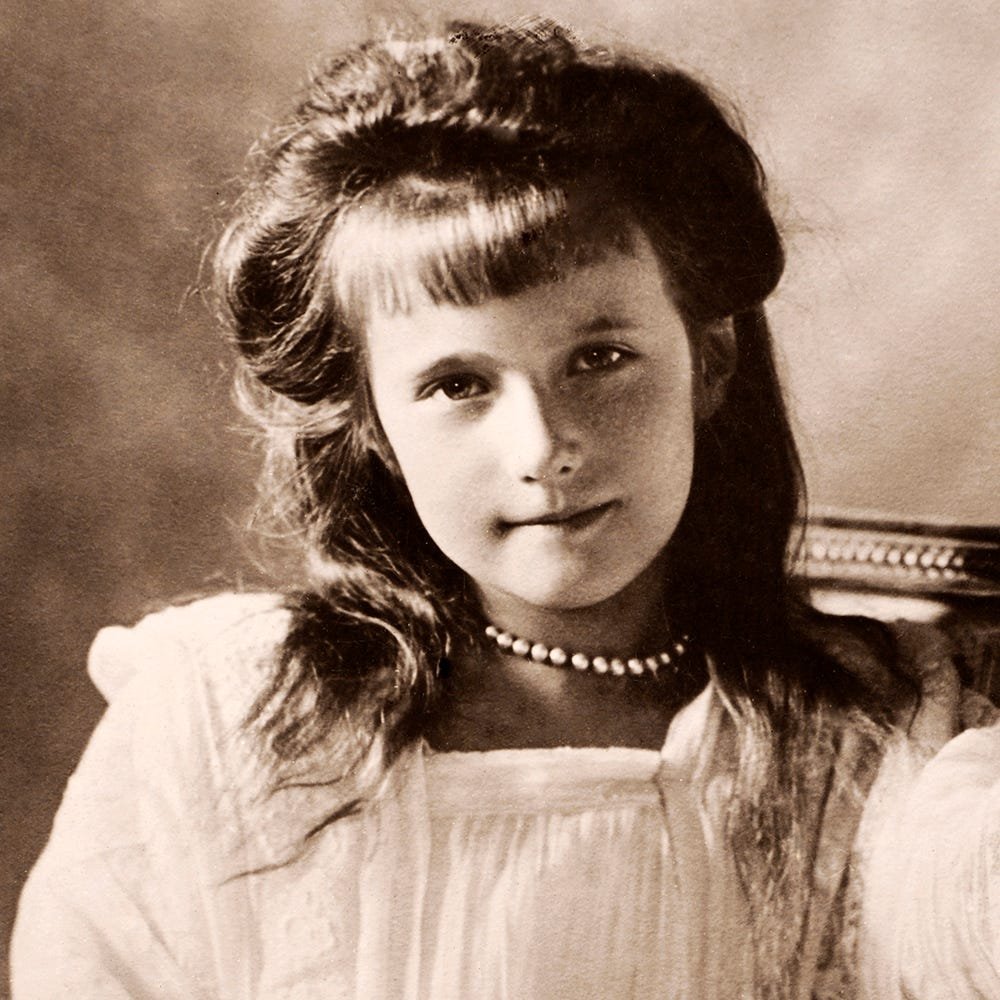
The most compelling claimant was Franziska Schanzkowska, a Polish factory worker who leaped from a Berlin bridge in 1920, claiming to be Anastasia. Rechristened Anna Anderson, she bore a striking resemblance: piercing eyes, Romanov jawline, and knowledge of intimate family details. Saved by a police officer, she was institutionalized, where Grand Duchess Olga’s friends visited and were initially swayed.
Anderson’s story: She was rescued from the basement by a guard named Alexander Tschaikovsky (hence her alias), hidden in a peasant cart, and smuggled to Romania, then Berlin. She recounted specifics like the layout of Tsarskoe Selo palace and Alexei’s hemophilia treatments. Supporters, including Gleb Botkin (son of the family physician), poured fortunes into her cause. She lived regally in castles, fought legal battles for Romanov inheritance, and starred in media spectacles.
Yet cracks appeared. Anderson spoke broken German with a Polish accent, not flawless Russian or French like Anastasia. Handwriting didn’t match. Still, she mesmerized until her death in 1984, outliving most skeptics. Her tale inspired books, plays, and the 1956 Ingrid Bergman film Anastasia.
A Parade of Pretenders and Media Madness
Anna wasn’t alone. In 1922, Marguerite Boudarel in France claimed to be Anastasia, citing prophetic dreams. Gatchina’s “Maturee” and others popped up worldwide. Some were pitiful—mental patients seeking attention—others opportunistic frauds eyeing fortunes from Romanov jewels or properties.
Media frenzy amplified it all. Newspapers ran sensational headlines: “Anastasia Lives!” Tabloids paid for interviews; films glamorized the myth. The 1928 Broadway play Anastasia and Fox’s movie version turned her into a pop icon. Even serious outlets like The New York Times debated claimants. Royal relatives were divided: some, like Xenia of Russia, rejected them; others saw flickers of truth.
This era reflected post-WWI disillusionment—a craving for lost royalty amid republics and dictators. Impostors exploited it, but genuine mysteries lingered: Why the delayed body discovery? Bolshevik cover-ups fueled doubt.
The Grave Discoveries: Bodies Unearthed
Progress came in 1979 when amateur sleuth Alexander Avdonin and filmmaker Geli Ryabov located the main grave near Ekaterinburg. Containing nine skeletons—Tsar, Tsarina, three daughters, physician, servants—it was kept secret until 1991 amid Soviet collapse. Forensic experts confirmed identities via dental records, bullet wounds matching execution accounts.
Missing were Alexei and one daughter—presumed Anastasia or Maria. A second grave, found in 2007 just 70 meters away, held their charred remains, dumped separately to confuse trackers. Russian authorities exhumed, analyzed, and reburied them in St. Petersburg’s Peter and Paul Cathedral in 1998 and 2015, respectively.
These finds shattered impostor dreams but raised questions: Why separate burials? Gangrene theories for Alexei were debunked; it was logistical secrecy.
DNA Evidence: The Nail in the Coffin

The smoking gun was DNA. In 1994, British scientists matched Anna Anderson’s tissue (saved post-surgery) to Schanzkowska relatives—not Romanovs. Mitochondrial DNA from the graves linked perfectly: all females shared Alexandra’s haplotype, males Nicholas’s. Prince Philip donated blood, confirming maternal ties via Olga lineage.
1998 re-examination nailed it: the “missing” daughter’s remains matched Anastasia’s age, height (5’2″), dental anomalies. No survivors. Independent labs in the UK, US, and Russia concurred. The Russian Orthodox Church canonized the family as martyrs in 2000, closing the spiritual chapter.
Anderson’s defenders cried contamination, but overwhelming evidence silenced them. Science triumphed over romance.
The Enduring Legacy of the Anastasia Myth

Though debunked, the mystery endures. Books like Robert Massie’s The Romanovs, animations like Anastasia (1997), and novels keep her alive. It symbolizes lost innocence, revolution’s cruelty, and humanity’s love for underdog tales. Conspiracy theorists persist online, alleging body swaps or faked DNA.
Today, Ekaterinburg’s Church on the Blood honors the site. The Romanovs teach us about power’s fragility and truth’s persistence. Anastasia, real or imagined, remains history’s most enchanting ghost—a reminder that some stories refuse to die.
(Word count: 1,528)