
Ancient Greeks Built a 2,000-Year-Old Computer – And Its Secrets Still Haunt Modern Science
The Shipwreck That Rewrote History
Imagine diving into the deep blue Mediterranean, scavenging a 2,000-year-old shipwreck, and pulling up what looks like a corroded lump of bronze. That’s exactly what happened in 1901 when sponge divers off the Greek island of Antikythera stumbled upon a treasure trove. Amid statues, coins, and jewelry, they found fragments of gears and dials that baffled everyone. Archaeologists called it the Antikythera Mechanism – and get this: it’s basically an ancient Greek computer. Yeah, you read that right. Built around 100 BC, this bad boy could predict eclipses, track planets, and even tell you when the next Olympics were. How did they pull that off without electricity or silicon chips? Buckle up, because this story’s wilder than a sci-fi flick.
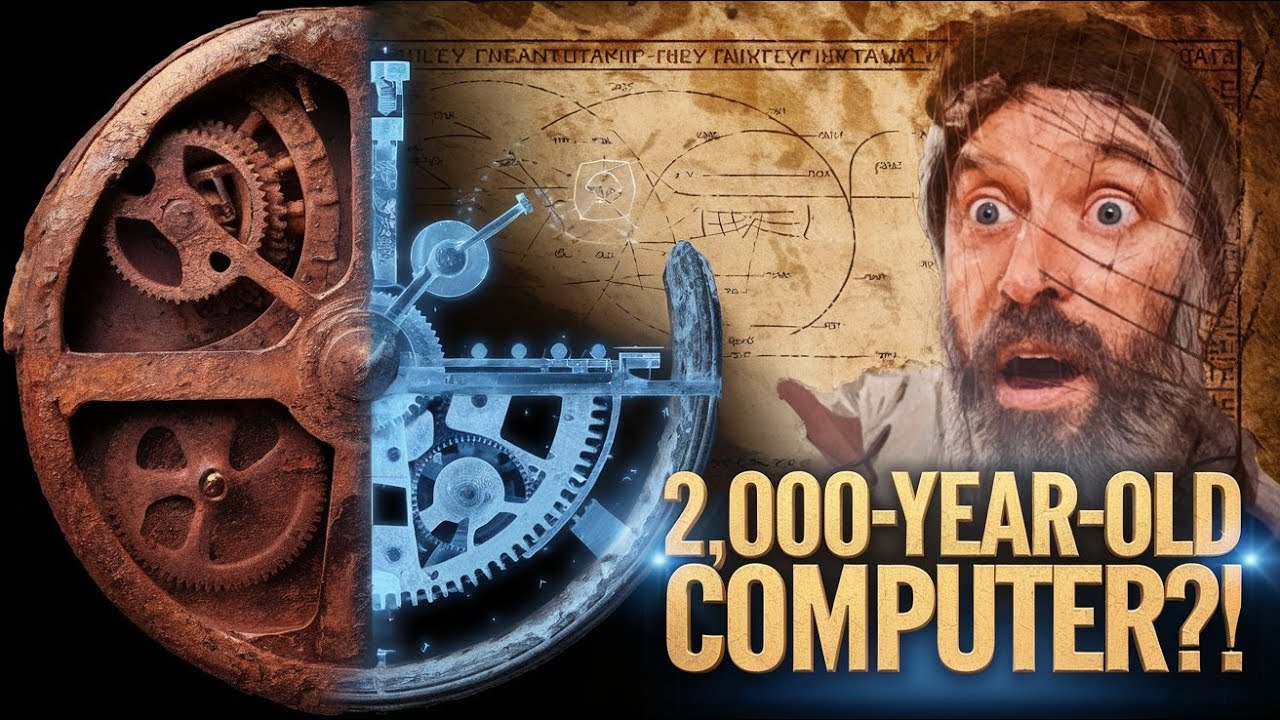
Unraveling the Guts: What This Thing Actually Did
Fast-forward to the 20th century. X-rays and CT scans finally cracked open its secrets in the 1970s and beyond. Picture a handheld device, about the size of a shoebox, packed with at least 30 interlocking bronze gears – the most complex gearwork known until medieval clocks. Turn a crank on the side, and voila: the front dial shows the zodiac and Egyptian calendar, spinning to today’s date. Another dial tracks the 19-year Metonic cycle for lunar phases. There’s even a pointer for the ancient Greek calendar of games, like the Olympics every four years.
But the real magic? It modeled the heavens. Saros cycles for eclipses, positions of the sun, moon, and five known planets (Mercury through Saturn). It simulated the irregular orbits we now know from Kepler’s laws – stuff the Greeks intuited with epicycle theory. Inscriptions on the sides, in elegant Koine Greek, spell out predictions: “203rd games of Poseidon,” or warnings like “Venus at evening rising.” It’s like having a pocket universe simulator from antiquity. Mind blown yet?
Engineering Marvel: Gears Smarter Than Your Watch
Let’s geek out on the tech. The gears aren’t uniform; they’re triangular-toothed beauties, cut with insane precision for the era. One standout is the pin-and-slot mechanism for the moon’s elliptical orbit – it bobs up and down realistically. Another replicates the moon’s phases with a little black-and-silver ball. The whole thing’s differential gear train anticipates planetary loops, a technique not “reinvented” until the 16th century.

Who built it? Hipparchus or Posidonius get fingered as suspects – math whizzes from Rhodes. Forged in a workshop rivaling clockmakers of 18th-century London, it required differential gears way ahead of their time. Cost? Probably a fortune, like a battleship for the brainy elite. And it worked for decades before sinking with a Roman cargo ship, maybe smuggling loot from Pergamon.
The Haunting Mysteries: What We Still Can’t Figure Out
Here’s where it gets spooky. Despite 3D prints, simulations, and supercomputers recreating it (shoutout to teams at UCL and Google), gaps haunt us. Missing pieces mean we can’t fully assemble it – only 82 fragments survive, a third of the original. What powered the planetary predictions? Some gears are AWOL, teasing unknown cycles. The back cover’s inscriptions cut off mid-sentence: “In the month of X…” – cliffhanger from Hades.
Then there’s the display: did it show Mars retrograde dancing? Evidence suggests yes, but how? A “broken gear” hypothesis posits wear and tear, but scans reveal intentional designs defying easy math. And the calendar? It syncs Egyptian and Corinthian systems oddly, hinting at a lost Greek zodiac variant. Freakiest: no known blueprints or duplicates exist. Did knowledge die with the maker? Or was it suppressed? Conspiracy nuts say aliens; rational folks blame the Dark Ages burning libraries. Either way, it’s a tech black hole sucking in modern minds.
Modern Science’s Obsession: Echoes in Today’s World
This isn’t dusty history – it’s a ghost in the machine of contemporary science. Analog computing? The mechanism’s daddy to everything from WWII bomb sights to your car’s ABS. NASA’s Jet Propulsion Lab studied it for Mars rover gear trains. AI researchers mimic its predictive cycles for chaos modeling. Even quantum computing nods to its differential genius.
Philosophically, it smacks us: Greek science peaked early, then poof. Why no Industrial Revolution in antiquity? The mechanism proves they had the brains and tools – lathes, dividers, screw-cutting. Social factors? Slavery dulled innovation? Or did Romans trash it as “pagan toys”? Today, it inspires projects like the Antikythera Replica at the Athens museum, cranked by visitors worldwide.
Scientists like Tony Freeth keep probing with AI scans, chasing that final 10%. In 2021, they decoded more text, revealing Olympiad details. But secrets linger: a possible “Mars pointer” or color-coded planets? It’s a reminder that history’s full of “impossible” feats, challenging our tech timeline.
Why It Matters to You (Yes, You)
Next time you glance at your smartphone’s star app, thank the Greeks. The Antikythera Mechanism isn’t just an artifact; it’s a taunt from the past. “We did this with bronze and elbow grease,” it whispers. “What’ll you do?” It haunts because it shows human ingenuity’s timeless – and fragile. One shipwreck preserved it; countless others erased peers. Dive into replicas online, watch docs like BBC’s, or visit Athens. Feel that crank turn, hear gears whisper cosmos secrets. In our digital age, it’s a analog soul reminding us: sometimes, the oldest tech holds the deepest truths.