
The Shocking Rise of Esports: How Gamers Are Earning More Than NBA Stars
Picture This: A Teenager Out-Earning NBA Pros
Imagine a kid in his bedroom, controller in hand, raking in millions while NBA stars sweat it out on the court for “only” seven figures. Sounds crazy? It’s happening right now. Esports has exploded from niche geek fest to a global juggernaut, where top gamers are pocketing more cash than many professional basketball players. Yeah, you read that right. In 2023, the total prize money in esports hit over $200 million, and that’s just the tip of the iceberg with sponsorships and streaming deals. Forget the slam dunks; it’s all about those headshots and strategies now. Let’s dive into how gaming went from basement hobby to billionaire-maker.
The Humble Beginnings: From LAN Parties to Arenas
Remember the early 2000s? Gamers huddled in dimly lit rooms for LAN parties, battling in StarCraft or Counter-Strike for bragging rights and maybe a $100 prize. Fast forward to today, and those same games—or their shiny successors—are filling stadiums with 100,000 screaming fans. The International, Dota 2’s flagship tournament, boasts prize pools exceeding $40 million annually. That’s more than the entire Stanley Cup Finals payout!
Esports kicked off seriously around 2010 with League of Legends Worlds drawing massive crowds. Organizations like Evil Geniuses and Team Liquid started treating players like athletes—coaches, trainers, even psychologists. Now, pros train 12 hours a day, live in team houses, and jet around the world. It’s pro sports, but with pixels instead of pigskin. And the money? It’s flowing like never before.
Prize Pools That Make Sports Jealous
Let’s talk numbers that shock. In 2024, Fortnite World Cup handed out $30 million. PUBG Mobile’s global champs? Over $10 million. Compare that to tennis Grand Slams, where winners get $3-4 million. NBA Finals? The whole series splits about $500K per player in bonuses—peanuts next to esports hauls.

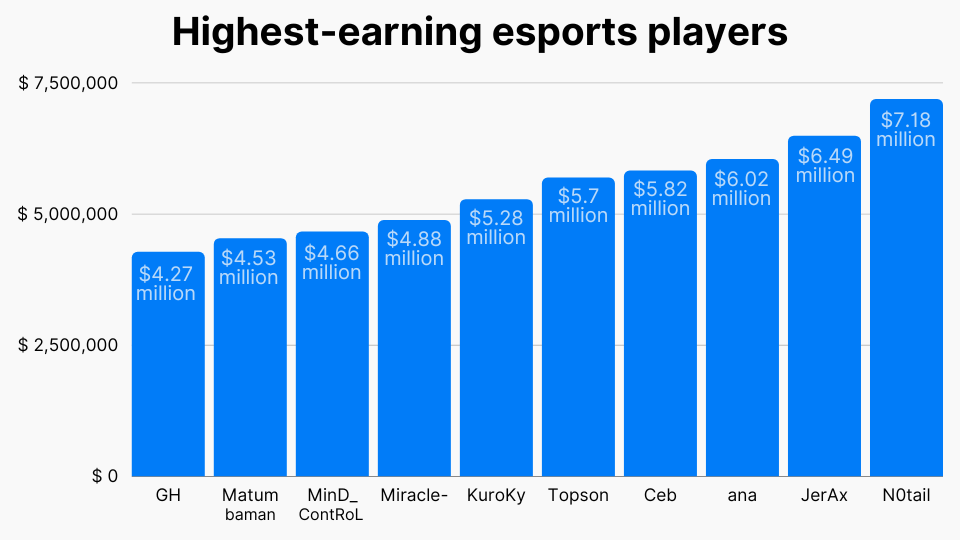
Top earners are legends. Johan “N0tail” Sundstein from OG has over $7.2 million in Dota 2 prizes alone, making him the highest-paid esports player ever. That’s before sponsors. Faker from T1 in League of Legends? $1.8 million in prizes, but his total career earnings top $10 million with endorsements. These guys aren’t scraping by; they’re building empires.
Gamers vs. NBA Stars: The Paycheck Showdown
Okay, NBA stars average $10 million a year, with LeBron at $50M+. But dig deeper. Many NBA role players earn $2-5 million annually. Enter esports phenoms like Kyle “Bugha” Giersdorf, who won $3 million at 16 in Fortnite. One tournament! Or Mongraal, pulling seven figures before turning 18.
Take Du “Adou” Pengyu from Honor of Kings—$8.2 million in prizes. That’s rivaling mid-tier NBA salaries over a career. And these gamers are younger, with lower injury risk—no ACL tears from pixel pushes. A 2023 report from Esports Charts shows top 10 earners averaging $5M+ lifetime, outpacing many NBA benchwarmers. Shocking? Absolutely. But it’s real.
The Streaming and Sponsor Bonanza
Prizes are flashy, but the real goldmine is off the battlefield. Twitch and YouTube superstars like Ninja (Tyler Blevins) earned $17 million in 2019 alone from streams and deals. Summit1g, Pokimane—they’re brands. Sponsorships from Red Bull, Intel, Louis Vuitton? Gamers rock designer gear courtside at Lakers games.
Team Liquid’s roster gets Nike deals. TSM partners with BMW. Annual salaries for top pros hit $1-2 million, plus bonuses. Contrast with NBA minimums at $1M for rookies—gamers leapfrog that straight out of high school. I mean, who needs college ball when you can drop out and dominate Valorant for Visa cash?
The Massive Global Audience Fueling the Fire
Why the cash explosion? Viewership. Esports hit 500 million viewers in 2023, per Newzoo. League Worlds finale: 6.4 million peak viewers. NBA Finals? Around 12 million, but split over games. China alone pumps billions into mobile esports like PUBG Mobile, with 200 million monthly players.
Demographics skew young—Gen Z spends more on gaming than sports tickets. Brands chase that eyeballs. Coca-Cola sponsors LCS; Mastercard backs Overwatch League. It’s a $1.8 billion industry growing 20% yearly, projected to hit $4 billion by 2027. Traditional sports? Stagnant or declining in some markets.
Challenges: Not All Glitter and Gold
To be fair, it’s not utopia. Burnout is real—pros retire by 25. Visa issues plague international teams. Scandals like match-fixing hit headlines. But leagues are pro-ing up: drug tests, salary caps, unions. ESL and Riot enforce rules like the NBA.
Still, the upside? Life-changing money without a 10-year grind. A Dota pro from Peru buys a mansion. A Korean LoL star becomes a national hero. It’s democratizing wealth—talent from anywhere wins.
The Future: Gamers Poised to Eclipse All Sports
What’s next? VR/AR esports, Olympics inclusion (yes, 2025 Asian Games has it). Saudi Arabia’s $45 billion Esports World Cup investment? Game-changer. Mobile gaming in India and Brazil will surge audiences to billions.
Predictions: By 2030, top gamers earning $20M+ yearly, surpassing NFL averages. NBA stars might pivot to streaming. Hey, LeBron’s already on Twitch! Esports isn’t replacing sports; it’s evolving them. If you’re a parent freaking out about “screen time,” tell your kid: it could be their ticket to millions.
This rise is shocking, inspiring, and undeniable. Gaming’s not just play—it’s the new power game. Who knew clutching a win in CS:GO beats a three-pointer for pay? The throne is shifting, and gamers are wearing the crown.