
How to Write a Cold Email That Actually Gets a Response: 10 Proven Strategies
Introduction to Cold Emailing Success
Feature Video
In today’s digital-first business landscape, cold emailing remains one of the most powerful tools for lead generation, networking, and sales outreach. But let’s face it: most cold emails end up in the trash folder faster than you can say “unsubscribe.” Studies from platforms like Mailchimp and HubSpot reveal that the average cold email response rate hovers around 1-5%, with many campaigns failing spectacularly due to poor execution. So, how do you write a cold email that actually gets a response? This comprehensive guide breaks it down into 10 proven strategies, backed by data and real-world examples, to boost your open rates, reply rates, and conversions. Whether you’re a sales rep hunting leads, a freelancer pitching services, or an entrepreneur building partnerships, mastering cold emails can transform your outreach game.
Understand Your Audience Before You Hit Send
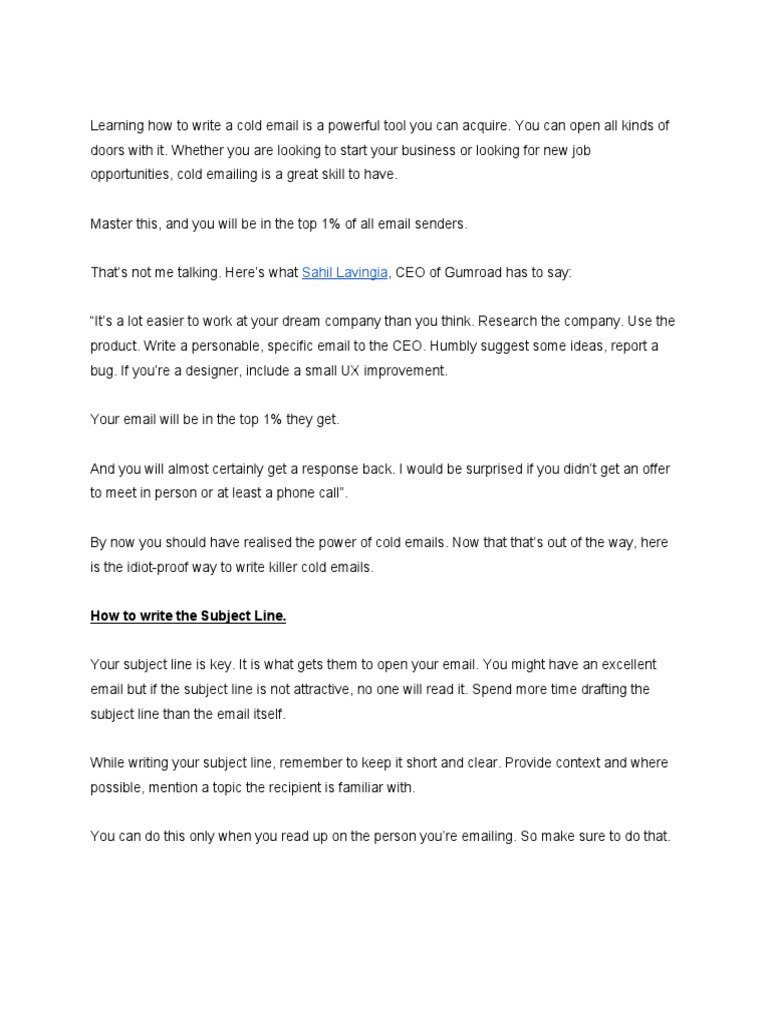
The foundation of any successful cold email starts with research. Generic blasts are dead; personalized outreach is king. Begin by identifying your ideal recipient. Use LinkedIn, company websites, Twitter, or tools like Hunter.io and Clearbit to gather intel on their role, recent achievements, pain points, and interests. For instance, if you’re emailing a marketing director at a SaaS company, reference their latest blog post on SEO challenges or a company announcement about expansion.
A study by Yesware found that emails with personalized subject lines get 22% higher open rates. Dive deep: What keeps them up at night? Tailor your message to address those specific needs. Avoid spraying and praying—focus on 50 highly targeted contacts per week rather than 500 mediocre ones. This targeted approach not only increases responses but also builds your sender reputation, reducing spam flags from email providers like Gmail.
Craft a Subject Line That Demands Attention

Your subject line is the gatekeeper—80% of emails are deleted based solely on this. Keep it under 50 characters, curiosity-driven, and value-packed. Ditch spammy tactics like “Free Money!” or ALL CAPS. Instead, use formats like:
- Question: “Struggling with [Pain Point]?”
- Value prop: “Boost Your Leads by 30% This Quarter”
- Personalized: “[Name], Quick Idea for Your Team”
Examples that work: “Sarah, loved your post on remote hiring” or “Idea to cut your ad spend in half.” A/B test subject lines using tools like Mailtester. Data from Campaign Monitor shows personalized subjects increase opens by 26%, while numbers or questions boost clicks by 14%.
Perfect the Email Structure for Maximum Impact
Structure matters. Aim for 50-125 words—BrevityMail research indicates shorter emails get 50% more replies. Use this proven formula:
- Compelling Hook (1-2 lines): Personal reference or bold value statement.
- Body (2-4 lines): Problem + Your Solution + Social Proof.
- CTA (1 line): Clear, low-commitment ask.
- Signature: Professional, with links to LinkedIn/portfolio.
Format for skimmability: Short paragraphs, bullet points, bold key phrases. White space is your friend—recipients scan on mobile 70% of the time.
Lead with Value, Not a Sales Pitch

Cold emails flop when they scream “Buy my stuff!” Instead, give first. Share a free resource, insight, or tip that solves an immediate problem. For example: “I noticed your site’s loading slow—here’s a quick fix that sped ours up 40%.”
Woodpecker.co’s analysis shows value-first emails double response rates. Back it with proof: “We helped [Similar Company] achieve [Result].” This positions you as a helpful expert, not a pushy seller. Always ask: “What’s in it for them?” before drafting.
Personalize Without Creeping Them Out
True personalization goes beyond “Hi [Name].” Mention specifics: “Congrats on the Q3 funding round!” or “Your TEDx talk on AI ethics was spot-on.” Tools like Lemlist automate this ethically. Avoid overkill—2-3 touches feel genuine; more seems stalkerish.
According to a Backlinko study, hyper-personalized emails see 32% higher reply rates. Balance warmth with professionalism: Use “Hi [First Name],” not “Hey buddy.”
Master the Call to Action (CTA)
A vague CTA kills momentum. Be specific and easy: “Reply ‘Yes’ for the full case study?” or “15-min call next Tuesday?” Limit to one ask. Vidyard reports emails with single CTAs get 371% more clicks.
Make it binary: Yes/No, or calendar link via Calendly. Urgency helps: “Spots filling fast this month.”
Proofread, Test, and Optimize Relentlessly
Typos scream amateur—Grammarly catches 90% but read aloud too. Test deliverability with Mail-Tester.com (aim for 9/10 score). Track metrics: opens (30-50% goal), replies (10-20%), using Yesware or GMass.
Segment lists and A/B test everything. Iterate based on data—what works for devs might bomb with execs.
The Art of Strategic Follow-Ups
One email rarely suffices—80% of sales require 5+ touches, per MarketingSherpa. Follow up 3-7 days later: “Quick bump—any thoughts?” Vary angles: Add new value each time.
Stop after 3-4 no-replies. Tools like Reply.io automate sequences. Follow-ups boost responses by 21%, per InsideSales.com.
Leverage Tools and Best Practices for Scale
Don’t DIY everything. Top tools:
- Find emails: Hunter.io, RocketReach.
- Send/Track: GMass, Woodpecker, Lemlist.
- Compliance: CAN-SPAM/GDPR—include unsubscribe, physical address.
Best practices: Warm up domains with Mailwarm, send Mon-Wed 8-10 AM recipient time, limit 50/day. Build lists organically via content marketing.
Common Pitfalls to Avoid
Steer clear of attachments (spam trigger), salesy language (“partner with us”), or lying about connections. Time zones matter—don’t email at 3 AM their time. Respect “no”—blacklist them.
Real-World Examples and Templates
Template 1 (Sales Lead):
Subject: [Name], Quick Win for [Company]’s Pipeline?
Hi [Name],
Saw [Company] hit 10k users—impressive!
We’re seeing 25% lift in demos with this tactic: [Brief Tip/Link].
Worth a 10-min chat?
Best,
[Your Name]
Template 2 (Job Pitch):
Subject: Thoughts on Your Open [Role] Posting?
Hi [Name],
Your [Role] req caught my eye—I’ve driven [Metric] at [Past Job].
Happy to share my approach?
Cheers,
[Your Name]
Adapt and test these for 15-30% reply rates.
Measuring Success and Scaling Up
Track KPIs: Open rate, reply rate, conversion rate. Aim for 40% opens, 15% replies. Use UTM tags for deeper analytics. Scale winners: Once proven, ramp to 200/week with warmed domains.
Conclusion: Start Getting Replies Today
Writing a cold email that gets responses boils down to empathy, value, and persistence. Implement these 10 strategies—research deeply, hook with subjects, deliver value, CTA clearly, follow up smartly—and watch your inbox light up. Cold emailing isn’t dead; bad cold emails are. Start small, measure, refine, and soon you’ll turn strangers into collaborators. Ready to craft your first winner? Your next big opportunity awaits in that draft folder.
(Word count: 1,248)