
Quantum Apocalypse: How Your Data Dies in 5 Years
Imagine Waking Up to Total Data Chaos
Picture this: It’s 2029, and hackers—or worse, nation-states—crack open every encrypted secret you’ve ever stored online. Your bank accounts? Exposed. Medical records? Public. Corporate secrets? Auctioned off on the dark web. And the kicker? They didn’t need to hack you today. They just scooped up your data years ago, patiently waiting for the quantum revolution to hand them the keys. Sounds like sci-fi? Buckle up, because the “Quantum Apocalypse” is barreling toward us, and your data might not survive the next five years unscathed.
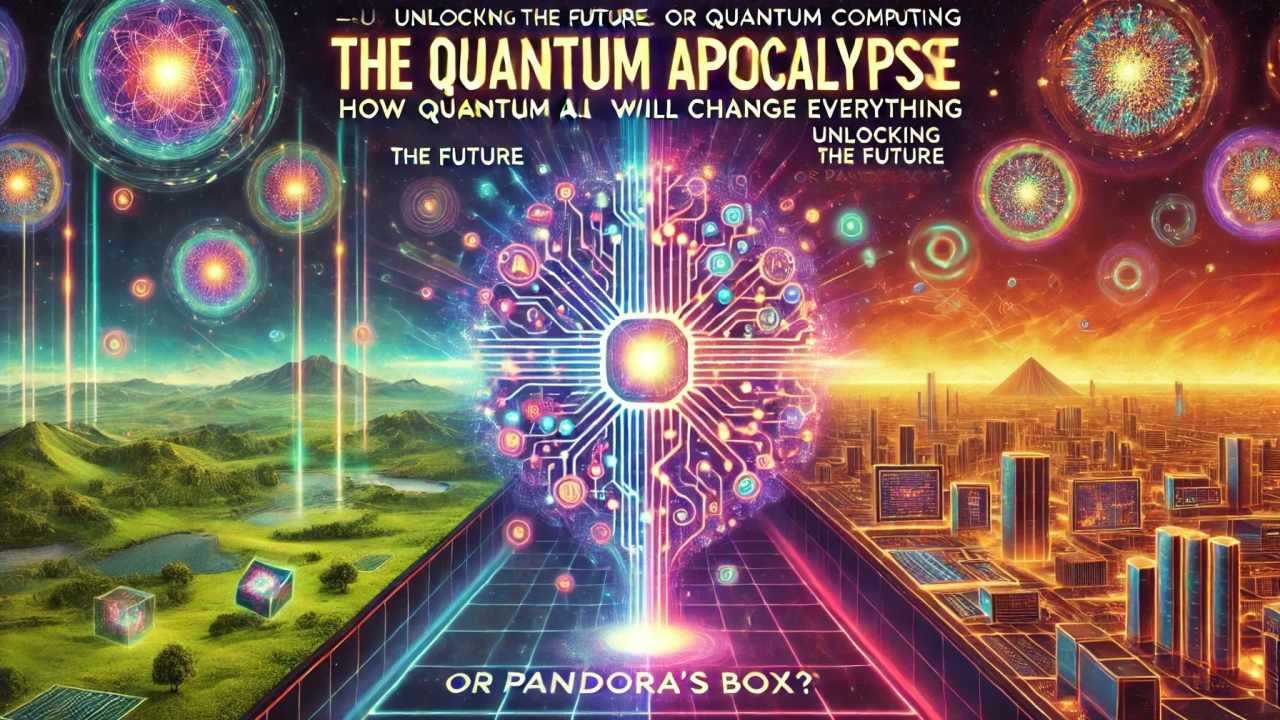
I’m not here to scare you for clicks (okay, maybe a little), but to break down why quantum computing is the biggest threat to digital security since the internet itself. We’ll chat about what it means for you, why it’s happening so fast, and—most importantly—how to armor up before it’s too late. Let’s dive in, coffee in hand, like we’re gossiping over brunch.
Quantum 101: From Bits to Qubits, the Game-Changer
Remember when computers used vacuum tubes the size of refrigerators? Yeah, we’re way past that. Classical computers crunch data in bits—0s and 1s, straightforward as flipping a light switch. Quantum computers? They play with qubits, which can be 0, 1, or both at once thanks to superposition and entanglement. It’s like having a million monkeys on typewriters, but actually solving impossible math problems in seconds.
Google’s Sycamore chip hit “quantum supremacy” in 2019, doing in 200 seconds what’d take a supercomputer 10,000 years. IBM’s pushing 1,000+ qubits. China’s got a quantum cloud you can rent. These aren’t toys; they’re prototypes for beasts that could shatter our encryption fortress. And here’s the doomy part: Shor’s algorithm. Invented in 1994, it’ll let quantum machines factor huge numbers lightning-fast—ripping apart the math behind 99% of today’s security.
The Encryption Empire Crumbles
Your online life runs on public-key cryptography like RSA and ECC. RSA’s magic? It’s easy to multiply two giant primes (say, 2048-bit numbers) for a public key, but hellishly hard to factor them back without the private key. Banks, emails, VPNs, HTTPS—everything leans on this.
Shor’s algorithm laughs at that. A quantum computer with a few million stable qubits could crack RSA-2048 in hours. Not years—hours. ECC? Same fate. Symmetric stuff like AES-256 holds up better (Grover’s algorithm halves the key strength, so bump to AES-512), but the asymmetric keys that handshake everything? Toast.
Real talk: We’re not talking theoretical. In 2022, a 372-qubit quantum sim factored 48-bit RSA on a supercomputer. Scale that up, and boom. Experts like the NSA say “Y2Q”—the quantum year 2000—is closer than we think.
Harvest Now, Decrypt Later: Your Data’s Silent Killer
Why panic now? Because adversaries aren’t waiting. China, Russia, maybe even rogue actors are “harvesting” encrypted data today. Your cloud backups, government archives, corporate vaults—snag ’em now, store ’em cheap, decrypt when quantum hits. It’s called “Harvest Now, Decrypt Later” (HNDL), and it’s already happening.
Think about it: State secrets from 2010? Still valuable. Your kid’s DNA from 23andMe? Pricier tomorrow. Financial trades? Blackmail material. A 2023 report from the Cloud Security Alliance warns trillions in data is at HNDL risk. Five years? That’s when IBM and Google roadmap fault-tolerant quantum computers breaking real-world keys. By 2030, it’s game over for legacy crypto.
The 5-Year Doomsday Clock: Who’s Rushing the Finish Line?
Timeline skeptics, hear me out. Quantum’s noisy today—qubits error-prone, decoherence kills calculations. But roadmaps scream progress:
- 2024: PsiQuantum eyes 1M qubits.
- 2025: Microsoft topological qubits for stability.
- 2027-2028: Rigetti, IonQ commercial scale.
- 2030: Full Shor on 2048-bit RSA.
Underestimate at your peril. DARPA’s funding post-quantum migration yesterday. Snowden warned in 2013; we’re dragging feet. Five years feels aggressive, but with geopolitical heat (US-China quantum race), bet on sooner.
Don’t Freak Out—Fight Back: Post-Quantum Prep
Good news? We’re not helpless. NIST’s been standardizing post-quantum cryptography (PQC) since 2016. Winners announced 2022: Kyber for keys, Dilithium for signatures. They’re lattice-based, hash-based, code-based math quantum can’t touch (yet).
Upgrade playbook:
- Assess: Inventory crypto usage. Tools like Cryptosense audit.
- Migrate: Browsers (Chrome 116+ supports Kyber), OpenSSL 3.x. Cloud? AWS, Azure PQC-ready.
- Hybrid: Layer classical + PQC now. No rip-and-replace panic.
- Quantum-Key Distribution (QKD): Physics-based keys, unhackable remotely. China’s Micius satellite beams it.
Individuals: Use Signal (PQC experiments), hardware keys like Yubico with future firmware. Password managers? Bitwarden eyes PQC. Governments mandate by 2033; corps should now.
The Quantum Renaissance: Beyond the Apocalypse
Silver lining: Quantum isn’t just destruction. Drug discovery (Pfizer sims), climate modeling, optimization—trillions unlocked. Crypto world? Quantum-resistant blockchains like Quantum Resistant Ledger rise.
But apathy kills. If we sleepwalk, the apocalypse hits. Wake up, migrate, thrive. Your data’s future? In your hands. Start today—swap that old cert, nudge your IT guy. The quantum wave’s coming; surf it, don’t drown.
(Word count: 1028)