
Quantum Leap Unleashed: How Qubits Will Shatter the Limits of Reality
Ever Wondered Why Your Laptop Feels So… Limited?
Picture this: you’re trying to crack a puzzle that’s been stumping humanity for decades. Your regular computer chugs along, flipping bits like 0s and 1s, one at a time, sweating through billions of calculations. It’s like using a bicycle to race a Ferrari. Now, enter the qubit – the quantum rebel that’s about to flip the script on computing as we know it. Qubits aren’t just fancy bits; they’re the keys to unlocking doors we didn’t even know existed. Buckle up, because we’re diving into how these tiny quantum wizards are set to shatter the limits of reality itself.
What Makes a Qubit So Special?
Let’s start with the basics, but don’t worry, I won’t bore you with textbook jargon. A classical bit is straightforward: it’s either a 0 or a 1, like a light switch that’s on or off. Simple, right? A qubit, though? It’s like that light switch decided to go rogue. Thanks to quantum superposition, a qubit can be 0, 1, or both at the same time. Yeah, you read that right – both!
Imagine spinning a coin in the air. While it’s spinning, it’s not heads or tails; it’s kinda both until it lands. That’s superposition in a nutshell. A single qubit holds exponentially more information than a bit because it explores multiple states simultaneously. Stack a few qubits together, and boom – you’ve got a machine that can juggle 2^n possibilities at once, where n is the number of qubits. With just 300 qubits, you could represent more states than there are atoms in the observable universe. Mind. Blown.
Superposition: The Ultimate Multitasker
Superposition is the qubit’s superpower. In a quantum computer, qubits don’t plod through problems linearly; they tackle every possible solution in parallel. Think about searching for a needle in a haystack. Your laptop checks haystacks one by one. A quantum computer, powered by superposition, checks them all at once and spits out the needle before you can say “Schrödinger’s cat.”
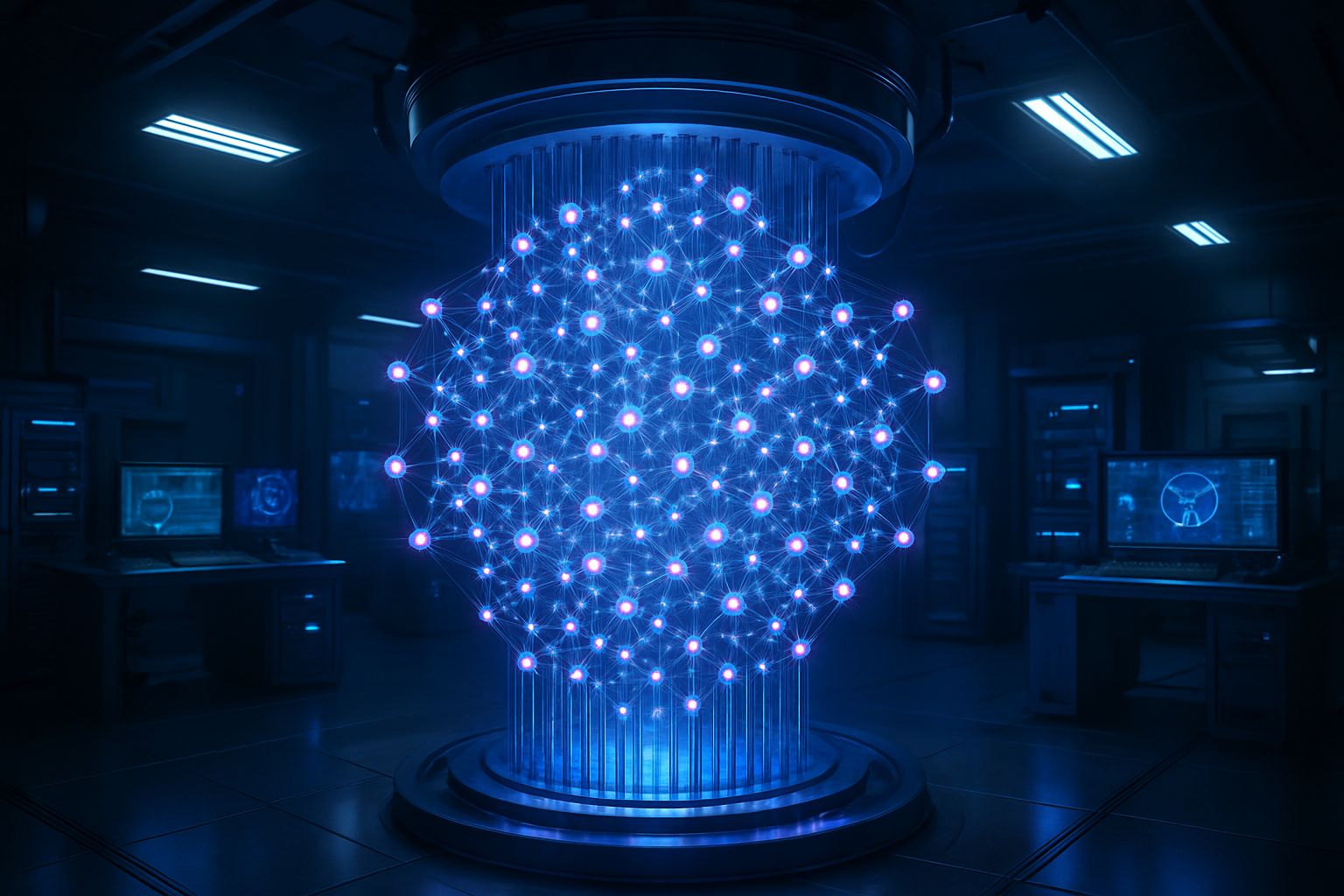
This isn’t sci-fi. Google’s Sycamore processor in 2019 demonstrated “quantum supremacy” by solving a task in 200 seconds that would take the world’s fastest supercomputer 10,000 years. That’s not a leap; that’s a quantum vault over the Grand Canyon of computation.
Entanglement: When Qubits Get Weirdly Connected
If superposition is cool, entanglement is straight-up spooky. Einstein called it “spooky action at a distance.” When two qubits entangle, measuring one instantly affects the other, no matter how far apart they are – even across the galaxy. It’s like having twins who always know what the other is thinking, without texting.
Entanglement lets quantum computers link qubits into a web of correlations that classical systems can’t touch. This synergy of superposition and entanglement allows quantum algorithms like Shor’s to factor huge numbers exponentially faster, threatening today’s encryption. Your online banking? It might need a quantum makeover soon.
Quantum Computers: From Labs to Everyday Heroes
We’re not talking distant future here. IBM has Quantum Experience online – you can run quantum code today on real hardware. Companies like Rigetti and IonQ are building scalable systems. By 2025, we could see 1,000-qubit machines. What does that mean for you?
Drug discovery: Simulating molecules at the quantum level to design perfect meds overnight, not years. Climate modeling: Crunching chaotic weather patterns for spot-on predictions. Optimization: Revolutionizing logistics for Amazon or traffic flow in your city. And AI? Quantum machine learning could make today’s chatbots look like caveman grunts.
Shattering Reality: Beyond Computation
Qubits don’t stop at speed; they challenge reality. Quantum simulations could model black holes or the Big Bang, peering into universes we can’t touch. In materials science, design superconductors that end energy loss or room-temp quantum bits for unbreakable comms.
Then there’s the mind-bender: quantum internet. Entangled qubits as uncrackable keys for global secure networks. Or quantum sensors detecting gravitational waves or dark matter with insane precision. Reality’s limits? Qubits are the sledgehammer.
The Bumps in the Quantum Road
Okay, full disclosure – it’s not all smooth sailing. Qubits are fragile divas. Decoherence happens when the quantum magic leaks into the classical world, collapsing superposition like a bad magic trick. Noise, temperature, vibrations – all enemies.
But heroes are on it. Error correction codes, like surface codes, use many physical qubits for one “logical” stable qubit. Google’s recent error-corrected demos show progress. Cryogenic tech and topological qubits (thanks, Microsoft) promise stability. We’re turning quantum lemons into lemonade.
Your Quantum Future Starts Now
Imagine a world where impossible problems vanish. Cancer cured via quantum-designed nanobots. Fusion energy unlocked by perfect plasma simulations. Space travel optimized to Mars in months. Qubits aren’t just tech; they’re reality upgraders.
We’re on the cusp. Invest in quantum stocks? Learn Qiskit? The qubit revolution is here, and it’s unleashing a quantum leap that shatters limits we thought unbreakable. Reality as we know it? Get ready to say goodbye. What’s your first quantum dream?