
NASA’s Secret Weapon: The Telescope That Could Prove Aliens Exist in 2025
Imagine Spotting Alien Life – For Real, in 2025
Hey there, space nerds and cosmic dreamers! Picture this: You’re scrolling through your feed one day in 2025, and BAM – NASA drops a bombshell image from a telescope that’s peering into the atmospheres of distant worlds. Not just rocks or gas giants, but planets that scream “habitable.” Oxygen? Check. Methane? Double check. Weird chemical combos that no natural process could explain? Holy cow, that’s a biosignature. We’re talking potential proof of extraterrestrial life. And the secret weapon making this possible? NASA’s James Webb Space Telescope (JWST). Yeah, that golden bad boy already in space, but 2025 is when it unleashes its full alien-hunting fury. Buckle up – this isn’t sci-fi; it’s science on the brink.
What Makes JWST NASA’s Ultimate Alien Detector?
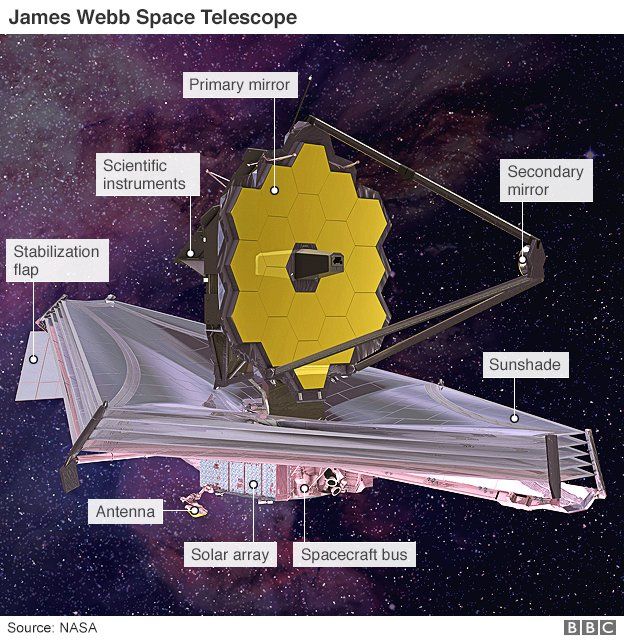
Let’s geek out on the tech for a sec. JWST isn’t your grandpa’s Hubble. Launched back in December 2021 after decades of hype (and a few billionaire space races), it’s parked a million miles from Earth at the L2 point, chilling in the shade to keep its infrared sensors ice-cold. Why infrared? Because that’s the sweet spot for spying on exoplanets – those far-flung worlds orbiting other stars.
Hubble was great for visible light, but JWST sees the heat signatures, the glow from planets too cool for visible wavelengths. It can peer through cosmic dust clouds that block other scopes and analyze the light filtering through a planet’s atmosphere during transits. Think of it like tasting the air on another world without ever leaving your couch. Instruments like NIRSpec and MIRI break down that light into spectra, revealing molecules like water vapor, carbon dioxide, and – crucially – gases that could signal life.
Is it a “secret weapon”? Well, NASA didn’t exactly advertise it as the ET finder from day one. Early missions focused on the early universe, galaxies, and star formation. But now, with prime time allocated to exoplanet surveys, it’s shifting gears. Programs like the “Cycle 3 Guaranteed Time Observations” in 2025 are laser-focused on habitable zones. We’re not talking Mars rovers; this is interstellar detective work.
2025: The Year the Stars Align for Alien Proof
Why 2025 specifically? Timing is everything in astronomy. JWST’s first year was calibration and shakedown cruises – stunning images of nebulae and black holes, sure, but exoplanet data takes time to process. By 2024, we’ve already got tantalizing hints: That 2023 detection of possible dimethyl sulfide (DMS) on K2-18b, a Hycean world 120 light-years away. DMS on Earth? Made by phytoplankton. Alien algae, anyone?
Come 2025, NASA ramps up with deep dives into TRAPPIST-1’s seven rocky planets, four in the habitable zone. JWST’s getting 100+ hours on these bad boys, sniffing for ozone layers or seasonal gas shifts that scream biology. Add in the PHANERTHOS program targeting 25+ Earth-like exoplanets, and you’ve got a data deluge. Astronomers predict we’ll map dozens of atmospheres by year’s end. One solid biosignature hit – like phosphine or unexplained disequilibrium chemistry – and the world changes. No little green men waving hello, but microbial life? Game over for “Earth alone” theories.
Don’t believe the hype? NASA’s own scientists are buzzing. Jane Rigby, JWST operations project scientist, called exoplanet atmospheres “the next frontier.” And with AI now crunching spectra faster than ever, false positives get weeded out quick.
From Hints to Hard Evidence: JWST’s Greatest Hits So Far
Let’s rewind to build the suspense. JWST’s exoplanet scorecard is already lit. Take WASP-39b: In 2022, it spotted CO2 in its atmosphere – first time ever. Then LHS 1140 b, a super-Earth with potential oceans. And don’t sleep on LTT 1445Ab, where water vapor was confirmed. These aren’t flukes; they’re proof JWST delivers.
Remember the Venus phosphine drama in 2020? JWST could settle that score on similar worlds. Or Proxima Centauri b, our nearest neighbor exoplanet – observations queued for 2025 could reveal if it’s a steamy hellscape or a life-friendly oasis. Each discovery stacks the deck. Statistically, with 5,000+ confirmed exoplanets and billions more out there, the odds favor life. Drake equation fans, your time is now.
Critics say biosignatures aren’t slam-dunks – abiotic processes mimic life sometimes. Fair point. But JWST’s resolution lets us model atmospheres in 3D, tracking weather patterns and surface interactions. If it’s life, it’ll leave a calling card too funky to ignore.
What If We Find Them? The Mind-Blowing Implications
Okay, fast-forward: It’s July 2025. NASA presser. “Biosignatures detected on TRAPPIST-1e.” Stock markets wobble, religions adapt, SETI amps up radio searches. Philosophically? We’re not alone. Biologically? Panspermia theories explode – did life hitchhike here from afar?
Practically, it supercharges funding. NASA’s budget gets a boost for follow-ups like the Habitable Worlds Observatory (2030s). Private players like SpaceX eye interstellar probes. You and me? We get to witness humanity’s biggest “aha” moment since Galileo.
But hold up – what if it’s empty? Still a win. We’ll learn why life is rare, refining our search. Earth stays special, but smarter.
How You Can Join the Hunt
Don’t just read – participate! Follow @NASAWebb on X (formerly Twitter) for live updates. Dive into citizen science via Zooniverse’s JWST projects, classifying spectra. Apps like Exoplanet Watch let you time transits from your backyard scope. 2025 is our year – mark your calendars for data drops in Q2 and Q4.
One last thought: Fermi Paradox asks, “Where is everybody?” JWST might answer, “Right under our infrared noses.” Fingers crossed, friends. The universe is about to get a lot less lonely. What’s your bet – microbes or megastructures? Drop a comment below!