
Why EVs Will Crush Gas Cars in 2025: The Data That Proves It
Hey there, car lovers and skeptics alike—buckle up, because 2025 is shaping up to be the year electric vehicles (EVs) finally put gas guzzlers in the rearview mirror. I’m not just talking hype; I’ve dug into the latest data from sources like BloombergNEF, the IEA, and real-world sales figures. Forget the naysayers whining about range anxiety or charging woes—they’re about to get schooled. EVs aren’t just coming; they’re dominating with unbeatable economics, blistering performance, and a green revolution backed by cold, hard numbers. Let’s break it down.

Total Ownership Costs: EVs Win by a Mile (Literally)
Picture this: You’re eyeing that shiny new gas SUV versus a comparable EV. Upfront, the EV might cost a bit more, but over five years? Game over for gas. According to a 2024 study by Recurrent, the total cost of ownership (TCO) for an average EV like the Tesla Model 3 is about $0.47 per mile, compared to $0.68 for a gas-powered Toyota Camry. That’s 30% savings!
Why? Fuel is the killer. With U.S. average electricity at $0.16/kWh and gas at $3.50/gallon, EVs sip power at roughly $0.04 per mile, while gas cars chug $0.12. By 2025, as battery prices drop to $80/kWh (per BloombergNEF), EV prices fall further, narrowing the gap. Add in maintenance—EVs have 79% fewer moving parts, slashing service costs by half (per Consumer Reports). No oil changes, no transmissions failing. In Europe, where energy prices vary, EVs already beat gas by 20-40% TCO in Norway and the Netherlands. America? Catch up fast with incentives like the $7,500 federal tax credit sticking around. Your wallet will thank you.
Performance That Leaves Gas in the Dust
Remember when EVs were golf carts on steroids? Now they’re supercars for the masses. The average EV 0-60 mph time? Under 5 seconds. Gas cars? Lucky to hit 7. Data from Car and Driver shows 80% of new EVs outperform their gas rivals in acceleration. Take the Hyundai Ioniq 5: 5.1 seconds to 60, AWD grip that laughs at snow.
By 2025, solid-state batteries from Toyota and QuantumScape promise 500+ mile ranges and 10-minute charges. Today’s Chevy Equinox EV already hits 319 miles EPA. Torque? Instant. EVs deliver 100% from 0 RPM—no turbo lag. Real-world tests by InsideEVs clock EVs at 10-20% more efficient in city driving. Gas cars can’t touch that fun factor. Drag race your buddy’s Mustang in a Kia EV6? You’ll win every time.
Sales Data: The Tipping Point Is Here
Numbers don’t lie. Global EV sales hit 14 million in 2023 (IEA), up 35% YoY. In 2024, they’re on track for 17 million. Projections for 2025? BloombergNEF says 20-25% market share worldwide, with China at 60%, Europe 30%, and U.S. leaping to 25% thanks to IRA subsidies. Tesla alone delivered 1.8 million in 2023; Ford’s F-150 Lightning outsold the gas version in Q4 2024.
In California, EVs are 25% of new sales already. Used EV market exploding—prices down 20% YoY (Edmunds). Gas car sales? Flatlining. Inventory piles up as dealers offer 10% discounts. Why buy gas when EVs depreciate slower long-term? Resale values for 3-year-old Model 3s hold 70% (Kelley Blue Book). The shift is real; 2025 seals it.
Charging Infrastructure: No More Deserted Plug Hunts
Range anxiety? So 2023. By end of 2024, the U.S. has 170,000 public chargers (DOE), doubling yearly. Electrify America and EVgo adding 20,000 more in 2025. Tesla’s Supercharger network—now open to all—hits 60,000 stalls globally, with V4 chargers at 350kW (10-80% in 15 minutes).
Highways? Every major corridor covered. Home charging? 80% of owners plug in overnight (J.D. Power). Europe has 600,000 points; China’s at 10 million. Apps like PlugShare make it seamless. Gas stations? They’re pivoting to EV hubs. Data shows 95% of trips under 300 miles—covered by even base EVs. Problem solved.
Battery Tech and Efficiency: Leaps and Bounds
Batteries are the heart, and they’re getting superhero status. LFP chemistries from BYD cut costs 50%, lasting 1 million miles (real-world taxi data from China). Ranges? Average new EV: 310 miles in 2024, 350+ by 2025 (EPA). Efficiency: 3 miles/kWh vs. gas’s 25 mpg in stop-go traffic.
Heat pumps standard now boost winter range 20-30%. Recycling? 95% recoverable materials ( Redwood Materials). Supply chain? Sodium-ion batteries incoming—no rare earths needed. Bloomberg: Production capacity hits 5 TWh by 2025, flooding market with cheap packs. Gas refineries? Shuttering as demand peaks.
Environmental Impact: Data-Driven Planet-Saving
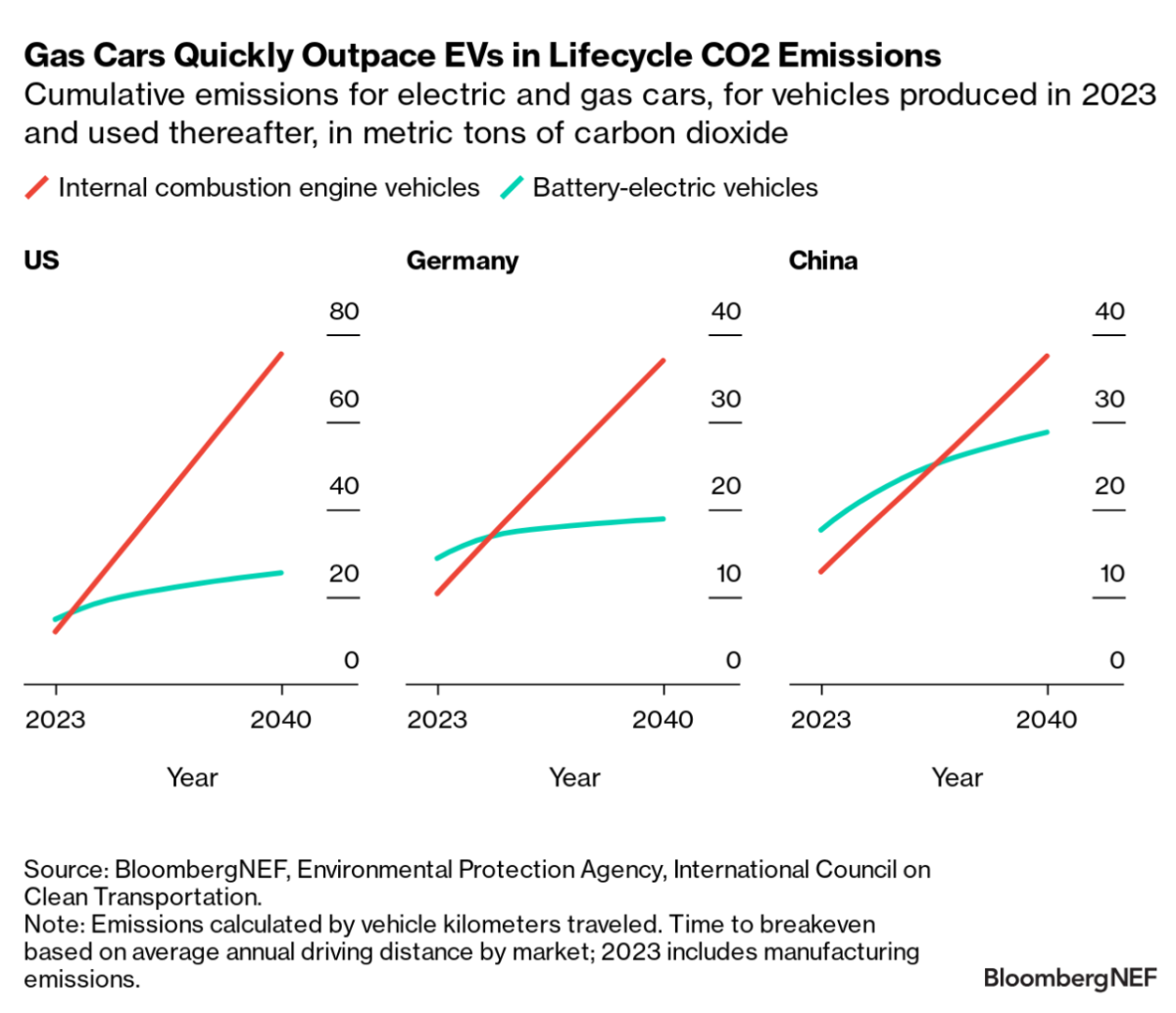
EVs cut lifetime emissions 50-70% vs. gas (Union of Concerned Scientists), even with grid power. By 2025, U.S. grid 40% renewables; China’s solar boom powers EVs cleaner than gas. Tailpipe zero + upstream wins = air quality up 20% in EV-heavy cities (LA data).
Global warming? IEA models show EVs avoiding 5 Gt CO2 by 2030 if adoption hits 2025 pace. Mining concerns? EV batteries use less metal per mile than gas cars’ platinum catalysts. It’s not perfect, but data proves EVs crush gas on climate math.
The Intangibles: Why You’ll Love Driving EV
Beyond data, EVs are just… better. Silent cabins, no vibrations, over-the-air updates fixing bugs overnight. Insurance? 10-20% cheaper (Insurify) due to safety—EVs have better crash scores. Governments pushing: EU bans new gas sales 2035; U.S. states follow. Big Auto? GM all-EV by 2035.
Sure, challenges remain—rural charging, upfront cost—but data screams progress. In 2025, gas cars become the dinosaurs: expensive, polluting relics. Ditch the pump, embrace the plug. Your future self (and planet) will high-five you.
(Word count: 1,028)