
The REAL Atlantis? India’s Sunken City of Dwarka Unearthed by Sonar
Deep beneath the waves of the Arabian Sea, off the coast of modern-day Gujarat in India, lies a mystery that has captivated archaeologists, historians, and mythologists alike. The submerged ruins of Dwarka, an ancient city linked to the legendary Lord Krishna, have been meticulously mapped using advanced sonar technology. Could this be the real Atlantis that Plato described over 2,300 years ago? Recent underwater explorations suggest that Dwarka’s ruins challenge our understanding of ancient civilizations and blur the line between myth and history.
The Mythological Roots of Dwarka
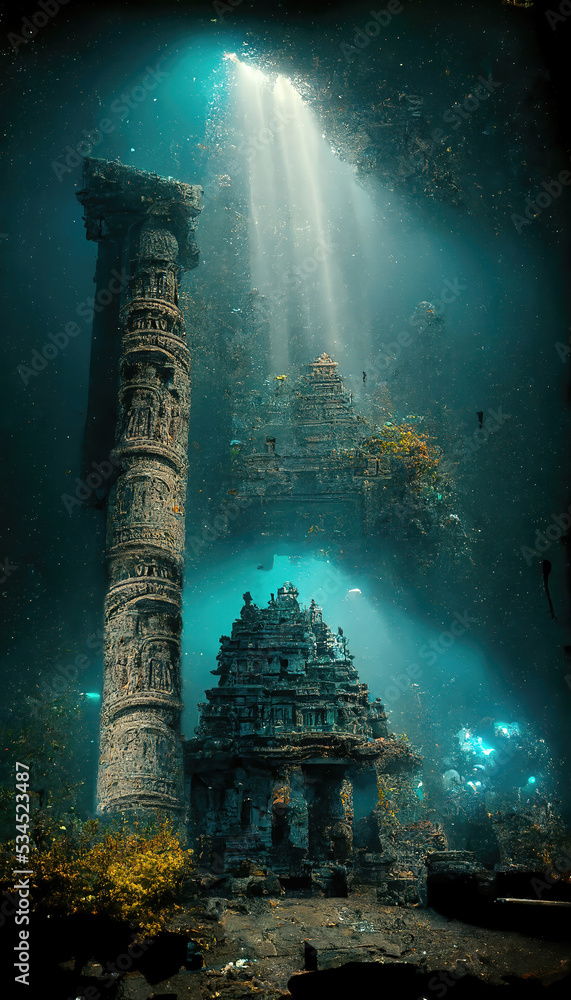
In Hindu scriptures like the Mahabharata and the Harivamsa Purana, Dwarka is portrayed as a grand metropolis built by Lord Krishna, the eighth avatar of Vishnu. Described as a fortified city with towering walls, palaces, wide streets, and bustling harbors, it was said to have sunk into the ocean following Krishna’s death around 3,100 BCE. Ancient texts vividly depict the city’s submersion in a single catastrophic event, with the sea swallowing its splendor overnight.
These accounts were long dismissed as mere mythology until the 20th century. Pilgrims and fishermen had reported strange structures visible at low tide near Bet Dwarka island, but it took scientific intervention to uncover the truth. The city’s location aligns precisely with these descriptions—situated at the Gomati River’s mouth, where it meets the sea, mirroring the scriptural geography.
Sonar Technology Revolutionizes the Search
The breakthrough came in the late 20th century through the efforts of India’s National Institute of Oceanography (NIOT) and the Archaeological Survey of India (ASI). In 1983, a team led by Dr. S.R. Rao initiated underwater surveys using side-scan sonar, a technology that employs sound waves to create detailed images of the seafloor.
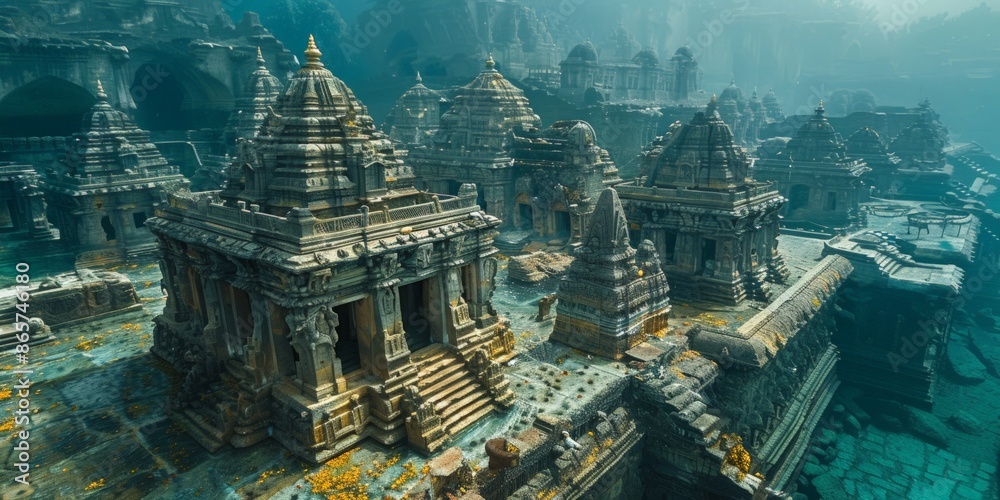
Sonar scans revealed massive geometric structures at depths of 30 to 40 meters—rectangular blocks, circular formations, and what appeared to be bastions and walls spanning over 2 kilometers. These weren’t natural rock formations; the precision suggested human engineering. By 2001-2002, NIOT’s expeditions using multibeam echo sounders produced 3D bathymetric maps, confirming a planned urban layout with harbors, warehouses, and residential areas.

Unlike traditional diving, which is limited by depth and visibility, sonar allowed non-invasive mapping of vast areas. High-resolution images showed stone anchors—triangular limestone blocks with holes for ropes—indicating a thriving maritime trade hub connected to ancient ports like Lothal in the Indus Valley Civilization.
Unveiling the Underwater Structures
Divers equipped with scuba gear descended to collect samples, revealing pottery shards, copper bells, iron stakes, and inscribed stone seals. The structures include a fortified embankment, three-meters-thick walls, and a jetty system capable of berthing large ships. One notable find is a massive wharf extending 250 meters, pointing to Dwarka’s role as a naval power.
Excavations at nearby Bet Dwarka yielded over 300 artifacts, including seals bearing script similar to the Indus Valley, dated to 2000-1500 BCE. Thermoluminescence dating on pottery places the occupation between 3500 BCE and 2000 BCE, with some layers suggesting continuity into the post-Harappan period. These discoveries position Dwarka as one of the oldest submerged cities, predating many known ancient harbors.
The sonar data also highlighted a “city grid” with orthogonal streets intersecting at right angles, a hallmark of advanced urban planning. Basalt columns and dressed stones, weighing up to 1,500 kilograms, were quarried from local sources, evidencing sophisticated construction techniques resilient enough to survive millennia underwater.
Dwarka vs. Atlantis: Striking Parallels
Plato’s Atlantis, detailed in “Timaeus” and “Critias,” was a naval superpower beyond the Pillars of Hercules (Strait of Gibraltar) that vanished into the sea “in a single day and night.” Dwarka’s sudden submersion, advanced maritime culture, and location opposite the Arabian Sea entrance evoke uncanny similarities. Both were ruled by divine or semi-divine figures—Krishna and Poseidon—and both met cataclysmic ends, possibly due to earthquakes and tsunamis.
Skeptics argue Plato’s tale drew from Egyptian records of real events, potentially the Minoan eruption or Thera’s collapse around 1600 BCE. However, Dwarka’s timeline fits even better, with geological evidence of a mega-earthquake and sea-level rise around 1500 BCE. Could Greek traders or philosophers have heard distorted tales of Dwarka via Persian or Egyptian intermediaries, morphing it into Atlantis?
Scientific Validation and Challenges
Carbon dating and stratigraphic analysis confirm multiple settlement phases. The earliest layers align with the Late Harappan culture (1900-1300 BCE), transitioning to a Painted Grey Ware phase linked to Mahabharata-era societies. Sediment cores show a rapid marine transgression—sea levels rose 10-15 meters post-1500 BCE—submerging the low-lying city.
Critics question the dating, citing potential contamination or natural formations mimicking ruins. Yet, peer-reviewed studies in journals like “Current Science” and NIOT reports affirm anthropogenic origins. Ongoing acoustic surveys using Remotely Operated Vehicles (ROVs) continue to refine the site’s map, ruling out geological anomalies.
Implications for Global History
Dwarka’s unearthing rewrites the narrative of ancient India as a cradle of high-seas trade and urbanism. It connects the dots between the Indus Valley Civilization and Vedic culture, suggesting Dwarka as a bridge. Artifacts like lapis lazuli beads indicate trade links to Mesopotamia, Egypt, and Central Asia, portraying a interconnected Bronze Age world.
For mythology enthusiasts, it lends credibility to epic tales, prompting questions about lost knowledge in architecture and navigation. Dwarka challenges Eurocentric views of civilization, highlighting India’s maritime prowess predating the Mediterranean powers.
Future Expeditions and Preservation
NIOT’s Project ‘Sagar Samrat’ and ASI collaborations plan deeper dives with autonomous underwater vehicles (AUVs). Climate change threatens the site with stronger currents and acidification eroding stones. In-situ preservation strategies, including digital twins from sonar data, aim to protect this heritage for posterity.
Tourism at Gomti Dwarka booms, with museums displaying replicas and artifacts. International teams from the US and UK express interest, potentially unlocking more secrets.
The sunken city of Dwarka stands as a testament to human ingenuity and nature’s power. Whether the true Atlantis or not, its sonar-unearthed ruins remind us that history lies hidden beneath the waves, waiting for technology to reveal it. As research progresses, Dwarka promises to illuminate the shadows of antiquity.