
Great Pyramid’s Hidden Void: Muon Scans Unveil Ancient Egypt’s 30-Meter Secret Chamber
In the shadow of the Giza Plateau, where the sands of time guard Egypt’s most enduring enigma, a groundbreaking discovery has reignited fascination with the Great Pyramid of Khufu. Advanced muon scans have revealed a colossal hidden void—a 30-meter-long chamber lurking within the pyramid’s ancient core. This revelation, born from the innovative ScanPyramids project, challenges long-held assumptions about one of humanity’s greatest architectural feats and promises to unlock secrets buried for over 4,500 years.
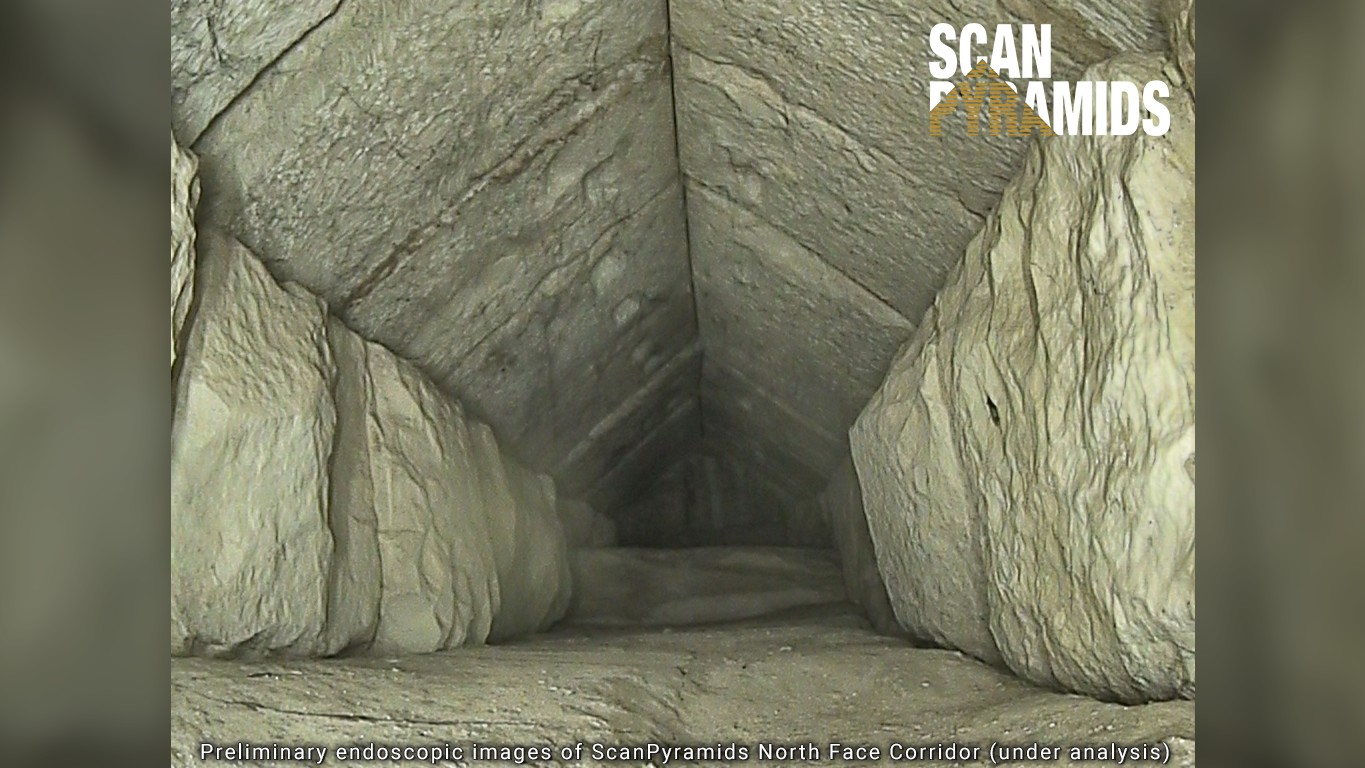
The Mystery of the Great Pyramid
Standing at 146 meters tall, the Great Pyramid is the largest of the three pyramids at Giza, constructed around 2580–2560 BCE during the reign of Pharaoh Khufu. Built from over 2.3 million limestone and granite blocks, it served as a tomb and a testament to Old Kingdom engineering prowess. For centuries, explorers and archaeologists have probed its corridors and chambers, uncovering the King’s Chamber, Queen’s Chamber, and the enigmatic Grand Gallery. Yet, vast sections remain unexplored, fueling speculation about hidden rooms or passages.
Traditional methods like drilling or radar have limitations inside the pyramid’s dense stone structure. Enter muon tomography—a non-invasive technique using cosmic ray muons, subatomic particles that pass through solid matter like natural X-rays. These particles, generated by cosmic radiation, reveal density variations, allowing scientists to map internal voids without disturbing the monument.
Birth of the ScanPyramids Project
Launched in 2015 by an international team of physicists, engineers, and Egyptologists from institutions like the University of Cairo, Nagoya University, and CEA Paris-Saclay, the ScanPyramids project aimed to peer inside the pyramids without excavation. Researchers deployed three types of muon detectors: gaseous tracking chambers, nuclear emulsion films, and scintillator-based systems.
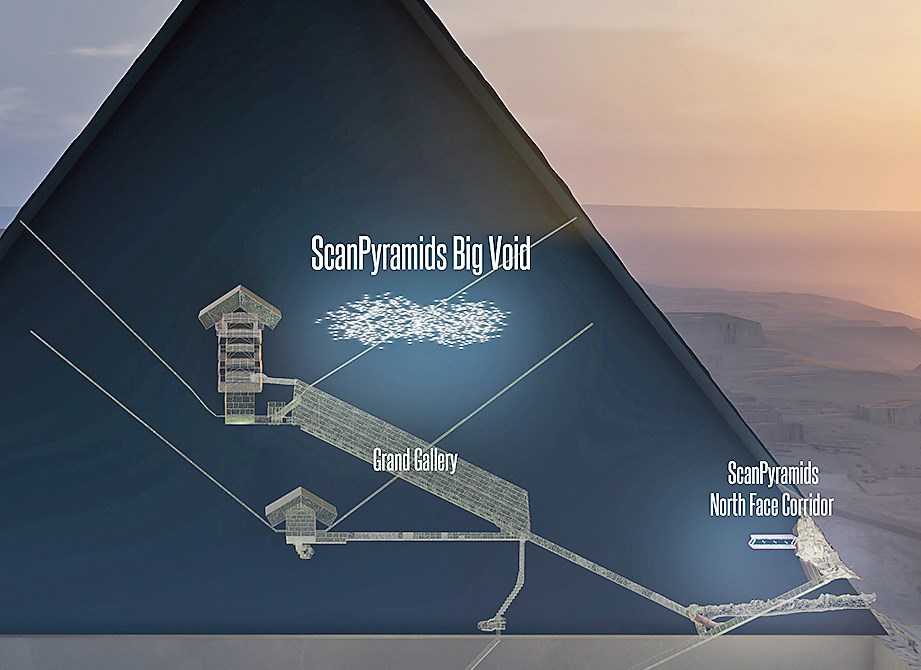
Over several campaigns from 2015 to 2017, detectors were placed inside known chambers and on the pyramid’s exterior. Muons showering from space at millions per square meter per day provided data. After meticulous analysis, the team identified anomalies: a smaller void near the north face (the “big void” precursor) and, most dramatically, a massive cavity above the Grand Gallery.
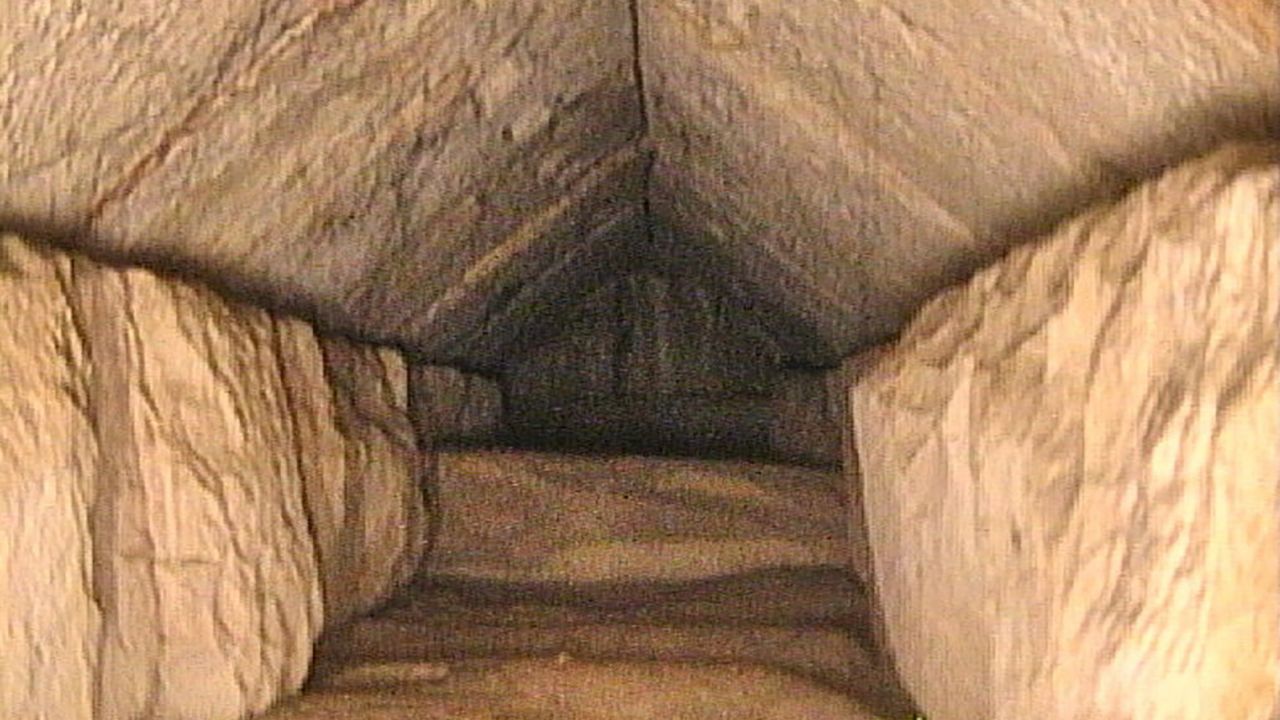
Unveiling the 30-Meter Void
Announced in November 2017 at the Cairo Radisson Hotel, the discovery stunned the world. The hidden void measures approximately 30 meters in length, with a cross-section similar to the Grand Gallery below it—about 8-10 meters high and 2 meters wide. Positioned roughly 40-50 meters above ground level, it spans from the gallery’s end toward the pyramid’s chevron entrance.
Statistical confidence exceeded five sigma—the gold standard in particle physics—ruling out measurement error. Visualizations from the data show a sharp drop in muon flux, confirming a low-density space amid the pyramid’s uniform granite and limestone. This chamber’s size rivals the King’s Chamber, making it one of the largest internal features yet undiscovered.
Engineering Marvel or Royal Secret?
What purpose does this void serve? Theories abound. One leading hypothesis posits it as a “reducing stress chamber,” akin to the five relieving chambers above the King’s Chamber, designed to distribute the pyramid’s immense weight and prevent collapse. Its elongated shape supports this, mirroring the Grand Gallery’s stress-relief role.
More tantalizing are ritualistic or funerary explanations. Could it house Khufu’s sarcophagus, overlooked treasures, or sacred artifacts? Ancient texts like Herodotus’s accounts hint at concealed chambers to thwart tomb robbers. Some speculate connections to the pyramid’s “air shafts,” which align with stars and may symbolize the pharaoh’s journey to the afterlife.
Skeptics note the void’s inaccessibility—no known entrance exists, suggesting deliberate sealing. Advanced construction techniques, like internal ramps or counterweight systems, might explain its placement, aligning with recent studies on pyramid-building logistics.
Implications for Ancient Egyptian Architecture
This find reshapes our understanding of pyramid design. The Great Pyramid’s precision—base sides aligned to true north within 3/60th of a degree, corners squared to within 14 cm—already defies explanation. The void suggests even greater complexity, possibly multi-level internal structures unseen in later pyramids like Khafre’s or Menkaure’s.
It validates non-destructive archaeology, preserving UNESCO World Heritage sites. Muon scanning has since probed other monuments, including Khufu’s satellite pyramids, revealing similar anomalies. Egyptologists now question if voids exist in every major pyramid, hinting at standardized yet secretive building practices.
Challenges and Future Probes
Accessing the void poses ethical and technical hurdles. Egypt’s Supreme Council of Antiquities mandates minimal intervention. Endoscopy via micro-cameras through existing fissures is proposed, similar to the 1993 “door” discovery in the Queen’s Chamber air shaft. Ground-penetrating radar and gravimetry could refine maps beforehand.
Funding and international collaboration continue, with 2023 updates confirming the void’s persistence in new datasets. AI-enhanced muon analysis promises higher resolution, potentially revealing corridors linking to the void.
Legacy of the Muon Revelation
The Great Pyramid’s hidden void transcends science—it’s a portal to antiquity. As muon scans demystify this wonder, they honor the ingenuity of ancient Egyptians who harnessed astronomy, mathematics, and labor on an epic scale. Whether engineering triumph or pharaonic vault, this 30-meter secret underscores why the pyramids endure as symbols of human ambition.
For enthusiasts, Giza beckons with virtual tours and ongoing excavations. Stay tuned as technology unveils more layers of this timeless puzzle, bridging 21st-century innovation with Bronze Age brilliance. The sands of Egypt still whisper untold stories, waiting for the next muon shower to illuminate them.