
Before Kitty Hawk: Hiram Maxim’s Giant Steam-Powered Flyer That Lifted Off First in 1894
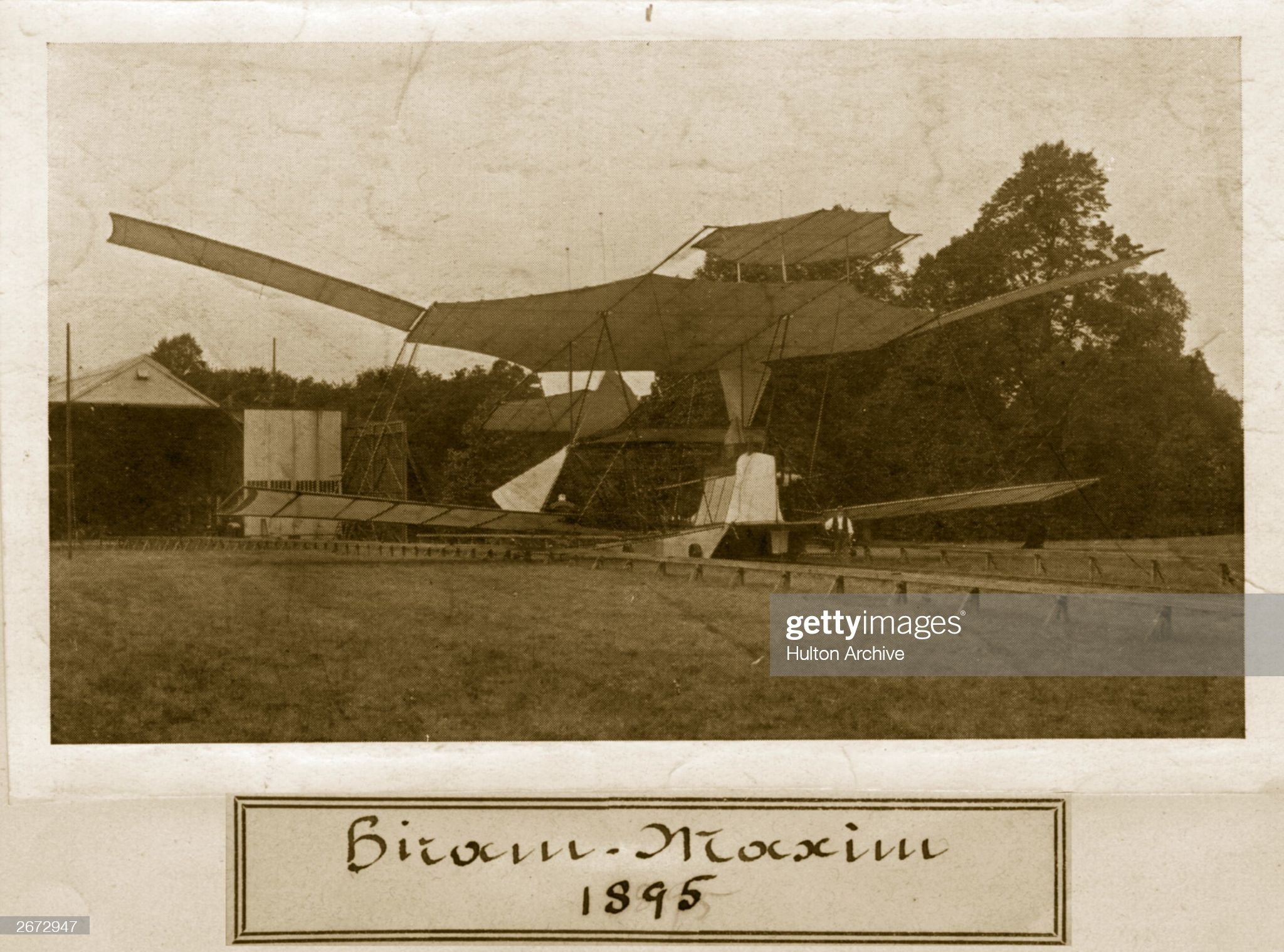
In the annals of aviation history, the Wright brothers’ 1903 flight at Kitty Hawk often steals the spotlight as the first powered, controlled flight. However, nearly a decade earlier, in 1894, British-American inventor Sir Hiram Maxim achieved a groundbreaking milestone with his massive steam-powered flying machine. This colossal contraption, tested on rails in England, briefly lifted off the ground, producing more lift than its own weight. Maxim’s experiment marked the first instance of a powered aircraft leaving the surface under its own power, challenging the traditional narrative of aviation’s dawn.
Who Was Hiram Maxim?
Hiram Stevens Maxim, born in 1840 in Maine, USA, was a prolific inventor whose ingenuity spanned multiple fields. Initially gaining fame for developing the Maxim machine gun in the 1880s—a weapon that revolutionized warfare—he turned his attention to the dream of human flight in the late 19th century. Knighted by Queen Victoria in 1901 for his contributions to science, Maxim’s fascination with aeronautics stemmed from his belief that mechanical flight was achievable through lightweight engines and aerodynamic principles.
Maxim’s background in engineering was impeccable. He held over 1,000 patents, including innovations in gas engines, fire sprinklers, and mousetraps. By the 1890s, he had settled in England, where he poured resources into aviation research. Frustrated by the limitations of gliders and unpowered models, Maxim sought a powered solution. His approach was bold: build a machine large enough to generate substantial lift, powered by reliable steam engines, the most advanced power source of the era.
The Late 19th-Century Quest for Flight
The 1890s buzzed with aviation fever. Pioneers like Otto Lilienthal soared on gliders in Germany, while Samuel Langley experimented with steam-launched models in the US. Hot-air balloons and kites had proven flight was possible, but sustained, powered, heavier-than-air flight remained elusive. Maxim studied these efforts meticulously, concluding that scale was key. Small models succeeded in wind tunnels, but full-scale machines needed immense power-to-weight ratios.
Inspired by birds and his own wind-tunnel tests, Maxim designed a monoplane with cellular wings—multi-layered structures mimicking insect wings for strength and lift. He calculated that a machine weighing several tons could fly if equipped with engines producing thousands of pounds of thrust. Construction began in 1890 at his Baldock works in Hertfordshire, England, involving a team of engineers and costing a fortune—equivalent to hundreds of thousands of dollars today.
Design and Specifications of Maxim’s Giant Flyer
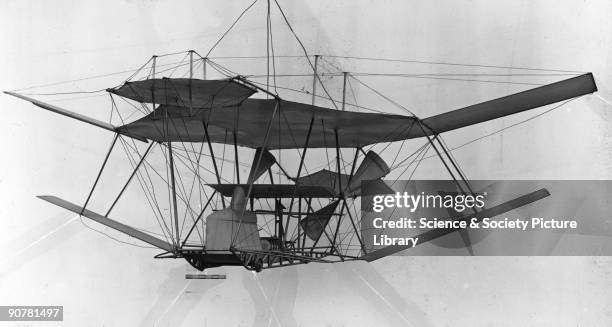
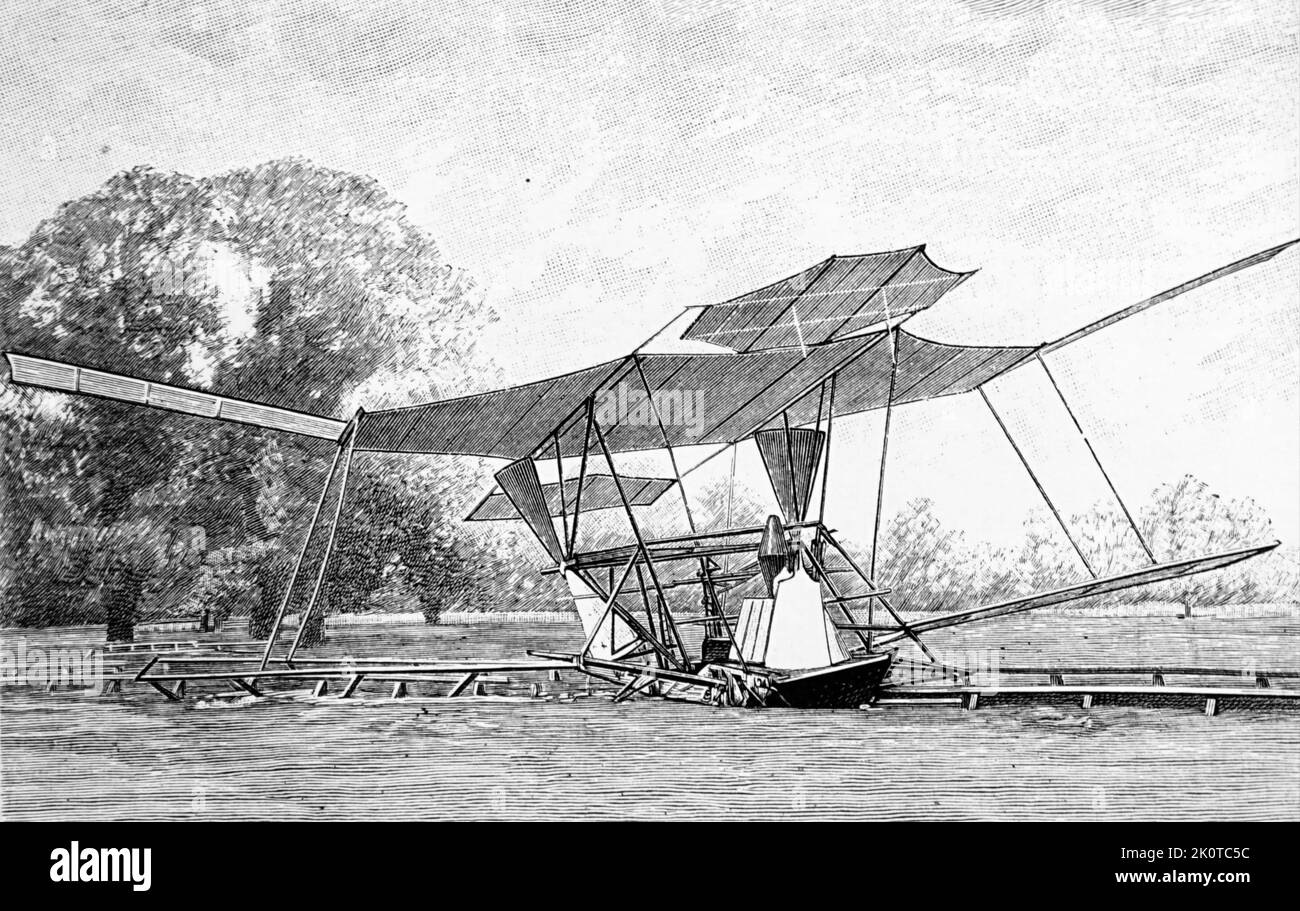
Maxim’s flying machine was a behemoth, dwarfing anything before it. The wingspan measured an astonishing 104 feet (31.7 meters), with a chord of 18 feet, creating a vast lifting surface of over 3,000 square feet divided into 17 cellular sections. The fuselage was 55 feet long, constructed from a tubular steel frame sheathed in varnished silk over wooden battens. Four wooden propellers, each 17 feet in diameter, were tractor-mounted in pairs.
Power came from two lightweight steam engines, each delivering 180 horsepower at 650 RPM, for a total of 360 hp. These Napier-built engines used high-pressure steam from two oil-fired boilers weighing just 1,200 pounds each. The entire apparatus tipped the scales at 3,300 pounds (1.5 tons) empty, ballooning to 3,700 pounds fueled and crewed. To manage takeoff, Maxim installed it on a 115-foot-long test track with 20-pound steel rails, complete with dynamometer wheels to measure thrust.
Safety features included a wheeled undercarriage and derailment flaps. Controls comprised warping wings for roll (a precursor to ailerons), a horizontal elevator for pitch, and a rudder for yaw—principles later refined by the Wrights. Maxim’s design emphasized stability and power, predicting a speed of 60 mph in free flight.
The Dramatic Test Flights of 1894
After four years of development, trials commenced on July 31, 1894, at Baldock. With Maxim at the helm alongside three crew members, the machine fired up its boilers. Spectators gathered as steam hissed and propellers whirred. Accelerating down the track, it reached 40 mph within seconds, thrust registering an incredible 4,000 pounds—far exceeding the machine’s weight.
The front wheels lifted off first, followed by the rear, raising the entire 3.7-ton structure several inches into the air. The crowd gasped as it hovered briefly, lift surpassing gravity. But the rails buckled under the strain, and a derailment flap deployed, snapping a propeller. Maxim shut down the engines to avert disaster. Subsequent runs repeated the lift-off, confirming the design’s viability, though full flight was curtailed by the track’s limitations.
Why Maxim’s Flyer Achieved Lift-Off First
Historians debate “first flight” definitions, but Maxim’s 1894 tests qualify under several criteria: it was powered, heavier-than-air, manned, and self-lifted without external aids like catapults. Unlike Langley’s 1903 tandem-wing failures or Clément Ader’s 1890 claim (unsupported by evidence), Maxim’s machine documented thrust exceeding weight via instruments. Eyewitness accounts and photos corroborate the event.
The rails prevented sustained flight, but this was intentional—a proof-of-concept phase. Maxim himself noted in his 1894 English Mechanic article: “The machine actually flew.” Free from the track, it would have continued, he believed, though steam boilers posed endurance limits of mere minutes.
Maxim Versus the Wright Brothers
The Wrights’ 1903 Flyer II achieved 59 seconds of controlled flight, using lighter gasoline engines and three-axis control perfected through glider tests. Maxim’s steam flyer was larger and more powerful but rail-bound and short-duration. Yet, it predated Kitty Hawk by nine years, proving powered lift was feasible. The Wrights acknowledged earlier pioneers, including Maxim, in their writings.
Key differences: Maxim prioritized raw power over control finesse; the Wrights emphasized stability. Both advanced aerodynamics—Maxim’s cellular wings influenced biplane designs, while his thrust data informed engine scaling.
Legacy of Hiram Maxim’s Steam Flyer
Though Maxim abandoned manned flight post-1894 (focusing on models and guns), his work rippled through aviation. It validated large-scale designs, inspiring Gustave Whitehead and the Voisin brothers. Modern replicas, like one built in 2011 by engineer Chris Darnell, have recreated the lift-off, affirming historical claims.
Museums preserve remnants: the Science Museum in London houses engine parts, while Maxim’s patents underpin early flight theory. His flyer underscores that innovation builds cumulatively—Kitty Hawk was a triumph, but Baldock was the spark. Today, as drones and eVTOLs evolve, Maxim’s bold engineering reminds us of the steam era’s untapped potential in aviation history.
In retrospect, Hiram Maxim’s giant steam-powered flyer wasn’t just a machine; it was a prophecy of skies conquered. Before Kitty Hawk’s sands, Baldock’s fields witnessed flight’s first powered whisper.