
Quantum Computing’s Hidden Power: Cracking Unsolvable Puzzles with Qubits That Defy Physics
Imagine a world where computers don’t just crunch numbers faster—they unravel mysteries that have stumped humanity for decades. Quantum computing harnesses the bizarre principles of quantum mechanics to tackle “unsolvable” problems, from optimizing global supply chains to simulating complex molecular structures. At the heart of this revolution are qubits, the quantum bits that operate beyond the rigid rules of classical physics, enabling superposition and entanglement to explore vast solution spaces simultaneously.
What Are Qubits? The Quantum Leap from Bits
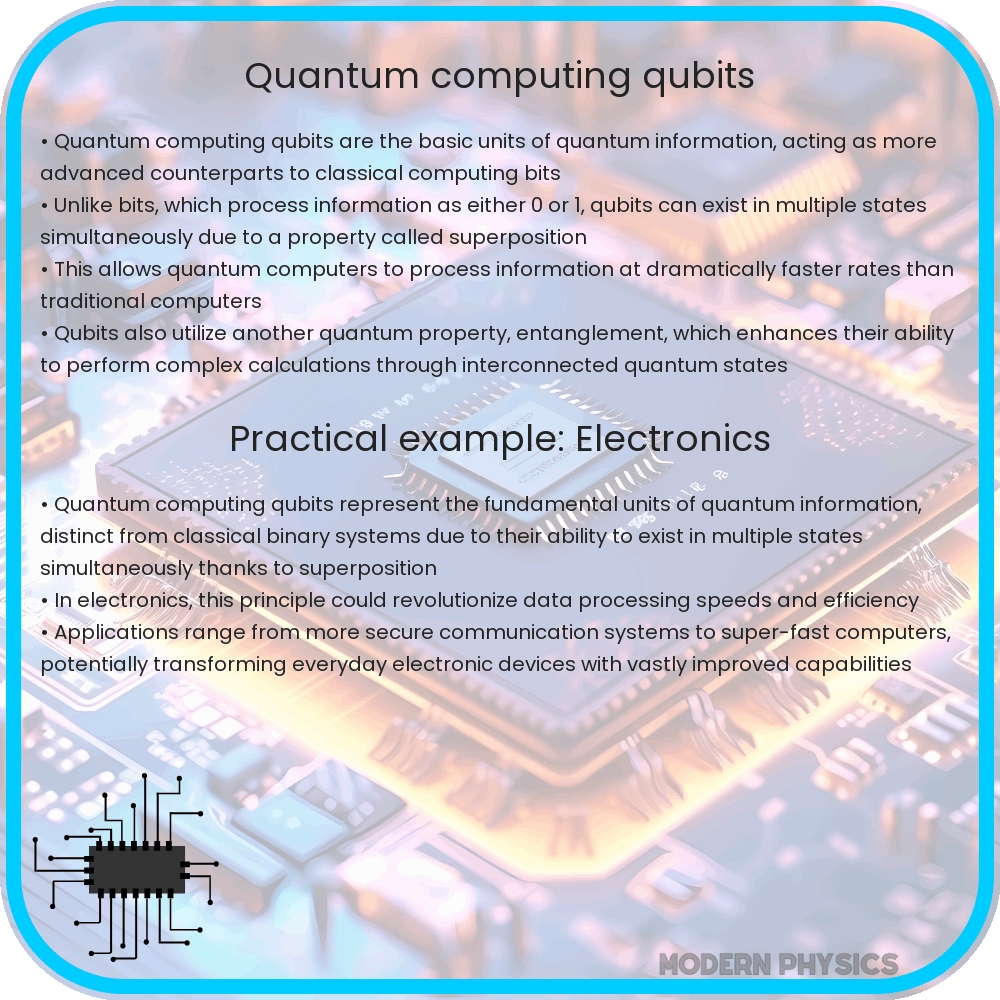
In traditional computing, bits are binary: either 0 or 1. Qubits, however, can exist in multiple states at once thanks to quantum superposition. This means a single qubit can represent 0, 1, or any combination of both until measured. Scale this up to hundreds or thousands of qubits, and you get exponential computational power. For instance, 300 qubits could theoretically represent more states than there are atoms in the observable universe.
Qubits are typically made from superconducting loops, trapped ions, or photons, each requiring ultra-cold temperatures near absolute zero to maintain coherence. Companies like IBM, Google, and Rigetti are pushing qubit counts higher, with IBM’s Eagle processor boasting 127 qubits and Condor at 1,121. This scalability is key to unlocking quantum advantage, where quantum machines outperform classical supercomputers on practical tasks.

Superposition and Entanglement: Physics-Defying Superpowers
Superposition allows qubits to process multiple possibilities in parallel, but entanglement takes it further. When qubits become entangled, the state of one instantly influences another, no matter the distance—a phenomenon Einstein called “spooky action at a distance.” This correlation enables quantum computers to explore solution landscapes holistically, solving optimization puzzles that would take classical computers billions of years.
Consider the traveling salesman problem, a classic NP-hard puzzle. Classical algorithms scale factorially with cities, becoming infeasible beyond dozens. Quantum annealing, used by D-Wave systems, leverages qubits to find near-optimal routes by tunneling through energy barriers, defying the sequential nature of classical search.

Quantum Algorithms: Cracking the Unsolvable
Peter Shor’s 1994 algorithm revolutionized cryptography by factoring large numbers exponentially faster than classical methods. RSA encryption, securing online banking and communications, relies on the difficulty of factoring products of large primes. A sufficiently powerful quantum computer could shatter this in hours, prompting the shift to post-quantum cryptography like lattice-based schemes.
Grover’s algorithm offers quadratic speedup for unstructured search problems. In a database of N items, classical search takes O(N) time; Grover’s needs only O(√N). This has implications for database queries, machine learning pattern recognition, and even blockchain verification.
More recently, the Harrow-Hassidim-Lloyd (HHL) algorithm solves linear systems crucial for simulations in finance and engineering. Quantum computers excel at matrix operations, enabling precise modeling of financial derivatives or structural stresses in aircraft design.
Real-World Applications Beyond the Lab
Quantum computing isn’t just theoretical. In logistics, Volkswagen used D-Wave’s quantum annealer to optimize traffic flow in Beijing, reducing congestion. Financial firms like JPMorgan Chase simulate portfolio risks with quantum variational algorithms, handling multivariate optimizations unattainable classically.
Materials science benefits immensely. Simulating electron behaviors in new alloys or batteries requires solving the Schrödinger equation for myriad particles—impossible classically beyond tiny systems. Quantum computers promise breakthroughs in high-temperature superconductors or efficient solar cells.
Climate modeling stands to gain too. Quantum-enhanced simulations could predict weather patterns or carbon capture efficiencies with unprecedented accuracy, aiding global sustainability efforts.
Milestones in Quantum Hardware
Google’s 2019 Sycamore processor achieved “quantum supremacy” by completing a random circuit sampling task in 200 seconds that would take Summit, the world’s fastest supercomputer, 10,000 years. While contested, it proved quantum potential. China’s Jiuzhang photonics system later claimed similar feats optically.
IBM’s Quantum Roadmap targets 100,000 qubits by 2033, with error-corrected logical qubits enabling fault-tolerant computing. IonQ and Honeywell focus on trapped-ion tech for high-fidelity gates, while neutral atoms offer scalability.
Challenges: Noise, Errors, and Scalability
Quantum systems are fragile. Decoherence from environmental noise causes qubits to lose information in microseconds. Error rates exceed 0.1% per gate, far from the 10^-15 needed for practical use. Quantum error correction (QEC) schemes like surface codes require thousands of physical qubits per logical one.
Cryogenic cooling and precise control add engineering hurdles. Hybrid quantum-classical approaches, like variational quantum eigensolvers (VQE), mitigate this by offloading optimization to classical hardware.
The Road Ahead: Quantum Internet and Supremacy
Experts predict “noisy intermediate-scale quantum” (NISQ) devices will deliver value in 5-10 years for specific tasks. Full fault-tolerant quantum computers, perhaps by 2040, could redefine industries.
A quantum internet, linking distant machines via entanglement, promises secure quantum key distribution (QKD) and distributed computing. Projects like the Quantum Internet Alliance are prototyping this.
Governments are investing billions— the U.S. National Quantum Initiative, EU’s Quantum Flagship—fueling a race with China. Private funding from Amazon Braket and Microsoft Azure Quantum accelerates cloud access.
In summary, qubits’ defiance of classical physics positions quantum computing to solve puzzles once deemed unsolvable. From shattering encryption to revolutionizing optimization, its hidden power is emerging, promising a computational paradigm shift. Stay tuned as this technology matures, transforming our world one superposition at a time.