
The Feynman Technique: How to Learn Anything Faster and Deeper
Introduction to the Feynman Technique
Feature Video
In today’s fast-paced world, mastering new skills and knowledge efficiently is crucial for personal and professional growth. Enter the Feynman Technique—a powerful learning method developed by Nobel Prize-winning physicist Richard Feynman. This technique simplifies complex concepts, enabling anyone to learn anything faster and deeper. By breaking down ideas into simple terms, it promotes true understanding rather than rote memorization. If you’re searching for effective learning strategies to boost retention and comprehension, the Feynman Technique is your answer. In this comprehensive guide, we’ll explore its origins, steps, benefits, and practical applications to help you unlock your learning potential.
Who Was Richard Feynman?
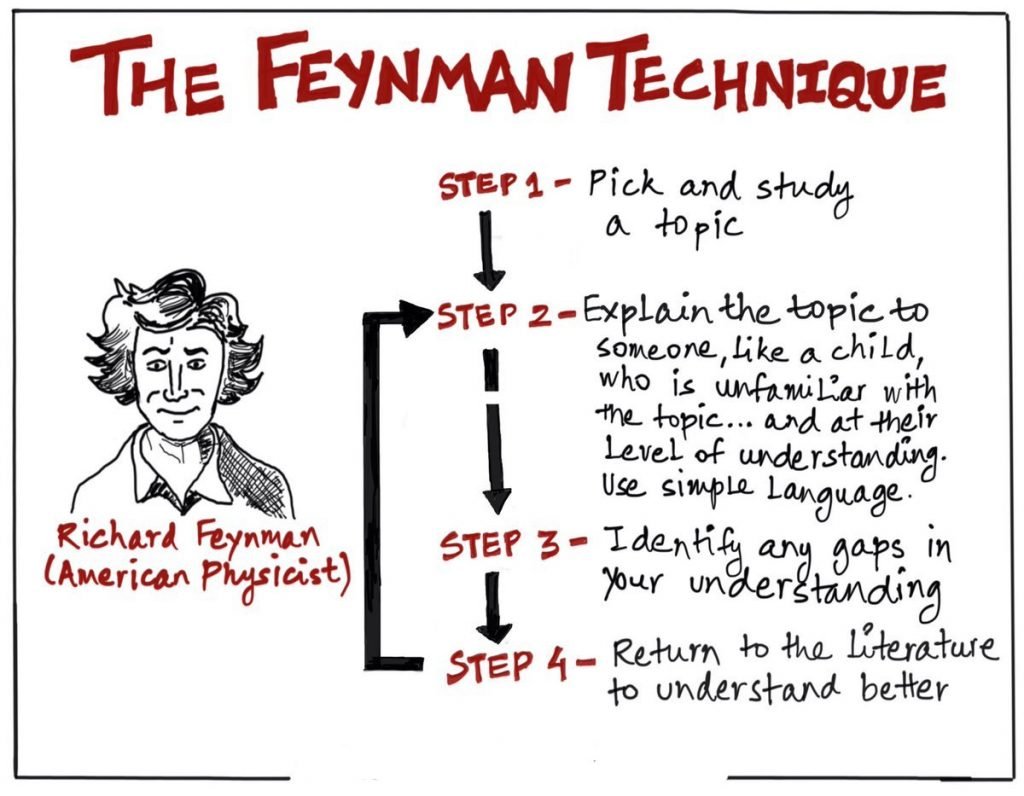
Richard Feynman (1918–1988) was an American theoretical physicist renowned for his work in quantum mechanics, quantum electrodynamics, and particle physics. He won the Nobel Prize in Physics in 1965 for his contributions to the latter field. Beyond his scientific achievements, Feynman was famous for his ability to explain intricate concepts in straightforward language. He often taught advanced topics to students and even children using everyday analogies, embodying the principle that if you can’t explain something simply, you don’t understand it fully. This philosophy forms the cornerstone of the Feynman Technique, a method he used informally to deepen his own knowledge and teach others effectively.
Feynman’s approach revolutionized how we think about learning. Unlike traditional methods that rely on passive reading or highlighting, his technique demands active engagement. It’s particularly valuable in fields like science, engineering, programming, and even business, where deep comprehension drives innovation and problem-solving.
The Four Steps of the Feynman Technique

The beauty of the Feynman Technique lies in its simplicity. It consists of four straightforward steps that anyone can follow. Here’s how to implement it:
Step 1: Choose a Concept and Study It

Start by selecting a topic you want to master—be it quantum physics, machine learning algorithms, or marketing strategies. Gather resources like books, videos, articles, or courses. Study the material actively, taking notes and highlighting key points. Avoid superficial skimming; aim for immersion. This initial phase builds your foundational knowledge, setting the stage for simplification.
For SEO enthusiasts, imagine applying this to understanding Google’s algorithm updates. Dive into official documentation, case studies, and expert blogs to grasp core concepts like E-A-T (Expertise, Authoritativeness, Trustworthiness).
Step 2: Explain It to a Child (or in Simple Terms)

Pretend you’re teaching the concept to a 12-year-old who has no prior knowledge. Write or speak the explanation using plain language, avoiding jargon. Use analogies, stories, and visuals. If you stumble or use complex terms, it signals gaps in your understanding—go back to step 1.
Example: Explaining electricity. Don’t say “electrons flow through conductors.” Instead: “Imagine water flowing through pipes. Electricity is like water pressure pushing tiny particles called electrons along wires to power your lights.” This step forces clarity and reveals true mastery.
Step 3: Identify Gaps and Review
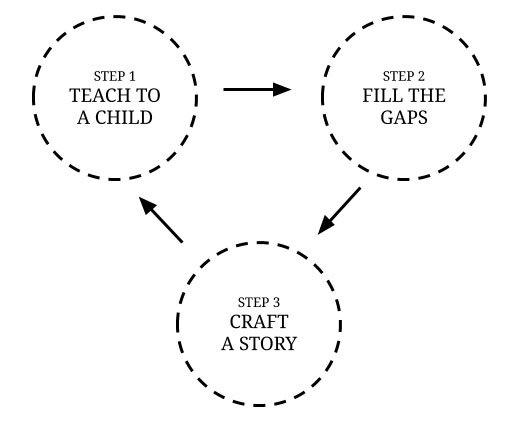
As you explain, note where you get stuck, use filler words like “uh,” or rely on technical terms. These are knowledge gaps. Return to your sources, study those areas deeply, and refine your explanation. Repeat until your simple version is seamless. This iterative process strengthens neural connections, making retention profound.
Step 4: Simplify and Use Analogies
Polish your explanation with metaphors and stories. Organize it into a narrative that’s engaging and memorable. Teach it to someone else—a friend, colleague, or even record yourself. Feedback refines it further. Now, you’ve internalized the concept at a deep level, ready for real-world application.
Benefits of the Feynman Technique
Why choose the Feynman Technique over other study methods? Its advantages are backed by cognitive science:
- Deeper Understanding: Simplification exposes superficial knowledge, ensuring conceptual mastery.
- Faster Learning: Active recall and teaching accelerate absorption by up to 90%, per learning research.
- Improved Retention: Explaining reinforces memory through the “protégé effect,” where teaching solidifies your own learning.
- Versatility: Applicable to any subject—math, history, coding, languages.
- Problem-Solving Boost: Simplifying aids innovation, as seen in Feynman’s bongo-playing inventions and Challenger disaster investigation.
Studies from educational psychologists like Dunlosky highlight that high-utility techniques like self-explanation outperform passive methods like rereading.
Real-World Examples of the Feynman Technique in Action

Consider learning calculus. Step 1: Study derivatives. Step 2: Explain: “Derivatives show how fast something changes, like your speed on a road trip.” Gaps? Review limits. Analogies: Graphs as hills and valleys.
In programming, tackle recursion: “It’s like Russian dolls—each opens to a smaller one inside, until the tiniest.” Tech professionals use it for blockchain: “A shared ledger where everyone checks transactions, like a group diary no one can forge.”
Students preparing for exams report 2-3x better scores. Professionals in AI and data science credit it for career advancements.
How to Apply the Feynman Technique Daily
Integrate it into your routine:
- Set Aside Time: 30-60 minutes per session, 3-5 times weekly.
- Use Tools: Notebook for writing explanations, rubber duck for “teaching,” or apps like Notion/Anki for flashcards.
- Combine with Others: Pair with Pomodoro for focus or spaced repetition for long-term recall.
- Track Progress: Journal simplified explanations; review monthly.
For SEO writers, use it to master keyword research: Explain semantic search as “Google understanding context, like chatting with a smart friend about ‘best running shoes’ and getting trail vs. road options.”
Common Mistakes and How to Avoid Them
Avoid these pitfalls:
- Skipping Simplification: Don’t stop at step 1; complexity breeds forgetfulness.
- Not Identifying Gaps: Be honest—record yourself explaining.
- Ignoring Analogies: Stories stick; facts fade.
- Overcomplicating: Aim for elementary school level.
- Lack of Iteration: One pass isn’t enough; refine relentlessly.
Patience is key—initial frustration signals growth.
Scientific Backing and Modern Adaptations
The technique aligns with evidence-based learning: Active recall (step 2-3) from cognitive load theory, elaboration from Bloom’s Taxonomy. Apps like Feynman AI or Explain Like I’m 5 forums digitize it. In corporate training, companies like Google use similar “teach-back” methods.
Conclusion: Master Learning with the Feynman Technique
The Feynman Technique isn’t just a study hack; it’s a mindset for lifelong learning. By teaching simply, you learn deeply and retain forever. Whether you’re a student acing exams, a professional upskilling, or a curious mind exploring passions, this method delivers results. Start today: Pick a concept, explain it plainly, and watch your understanding soar. Embrace Feynman’s wisdom—”What I cannot create, I do not understand”—and transform how you learn anything faster and deeper. Share your experiences in the comments and accelerate your journey!
(Word count: 1,248)